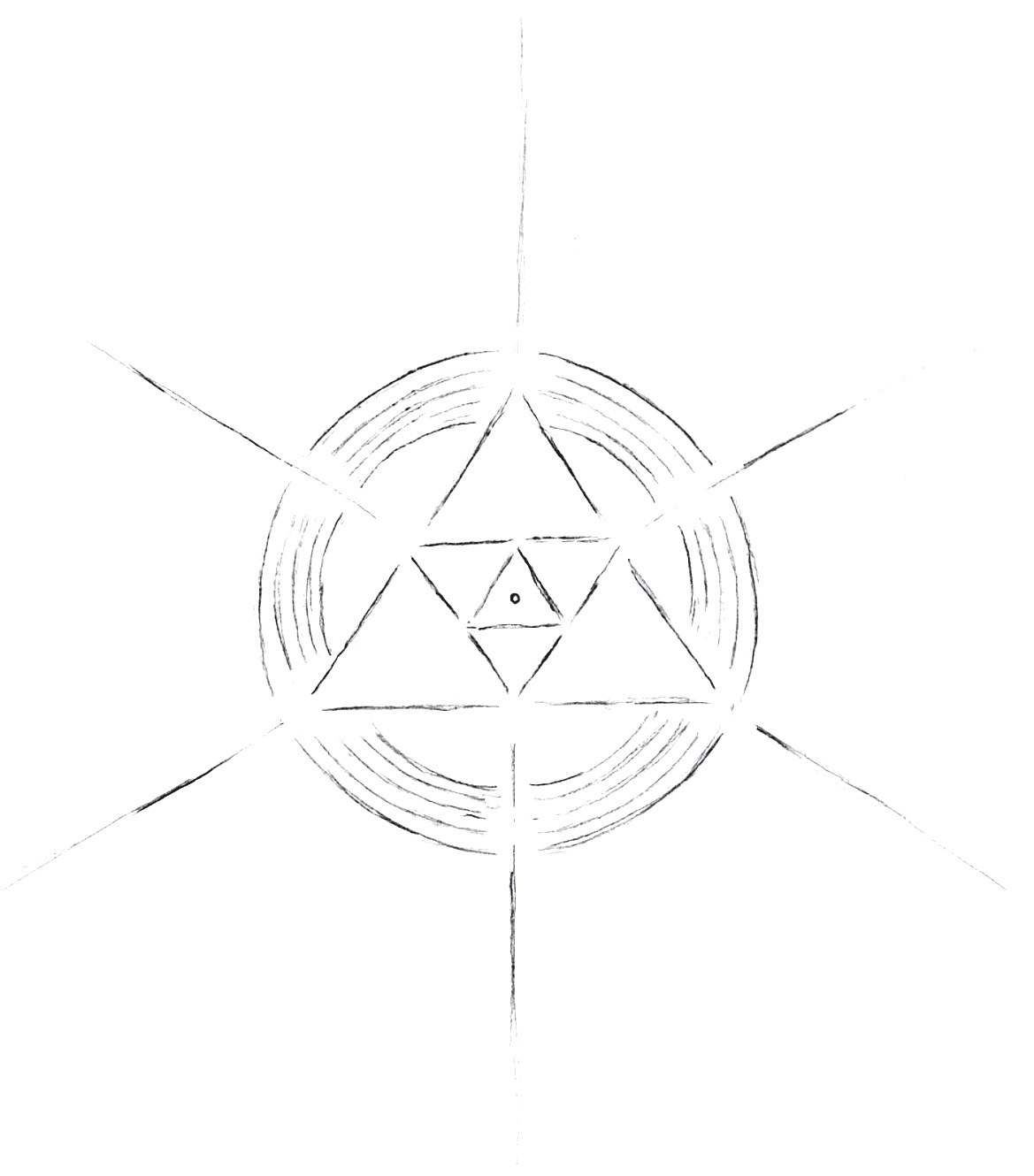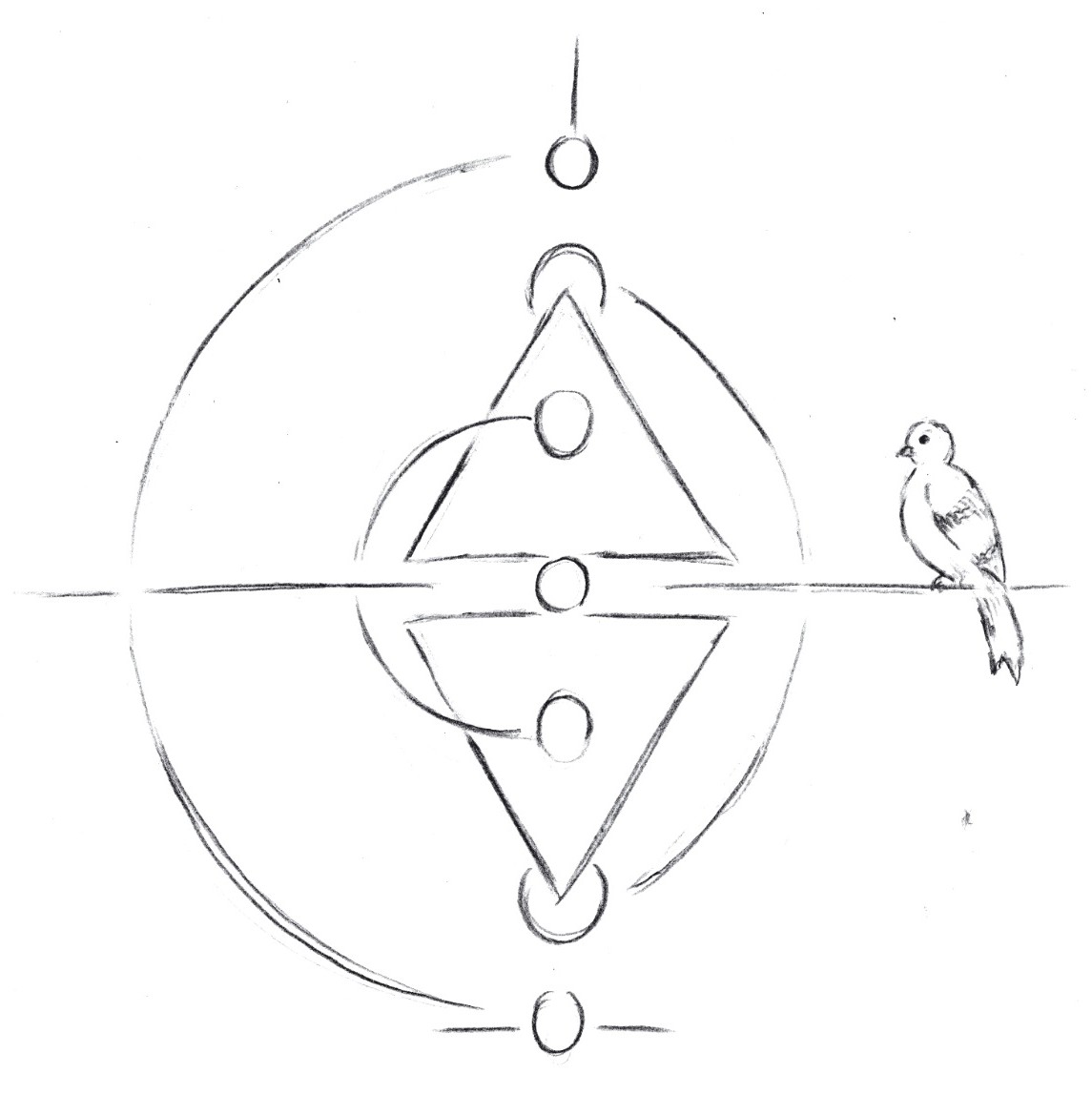
Ajna Chakra

Ajna Chakra

ĀJÑĀ Chakra

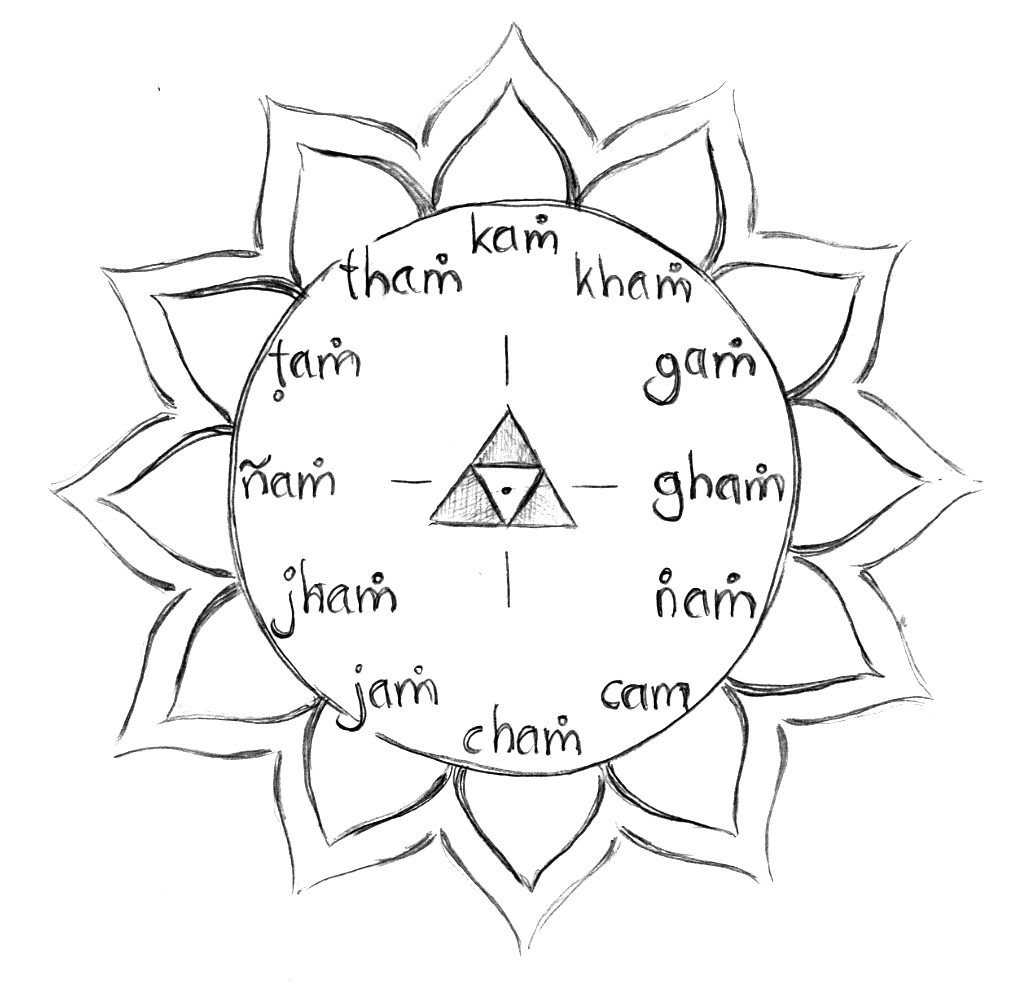
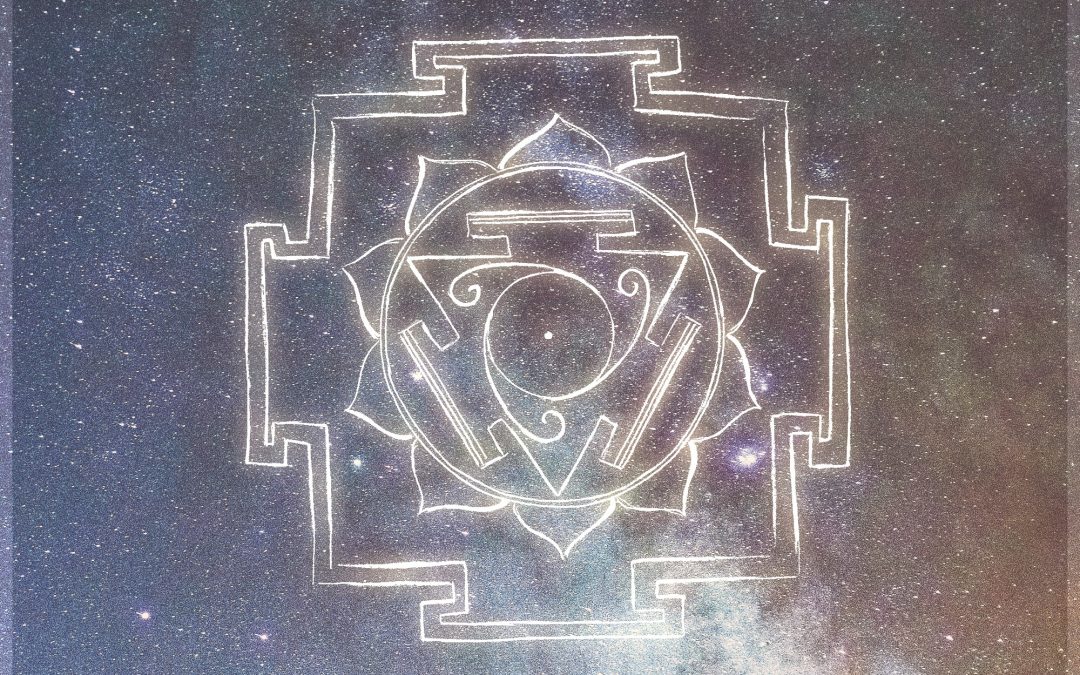
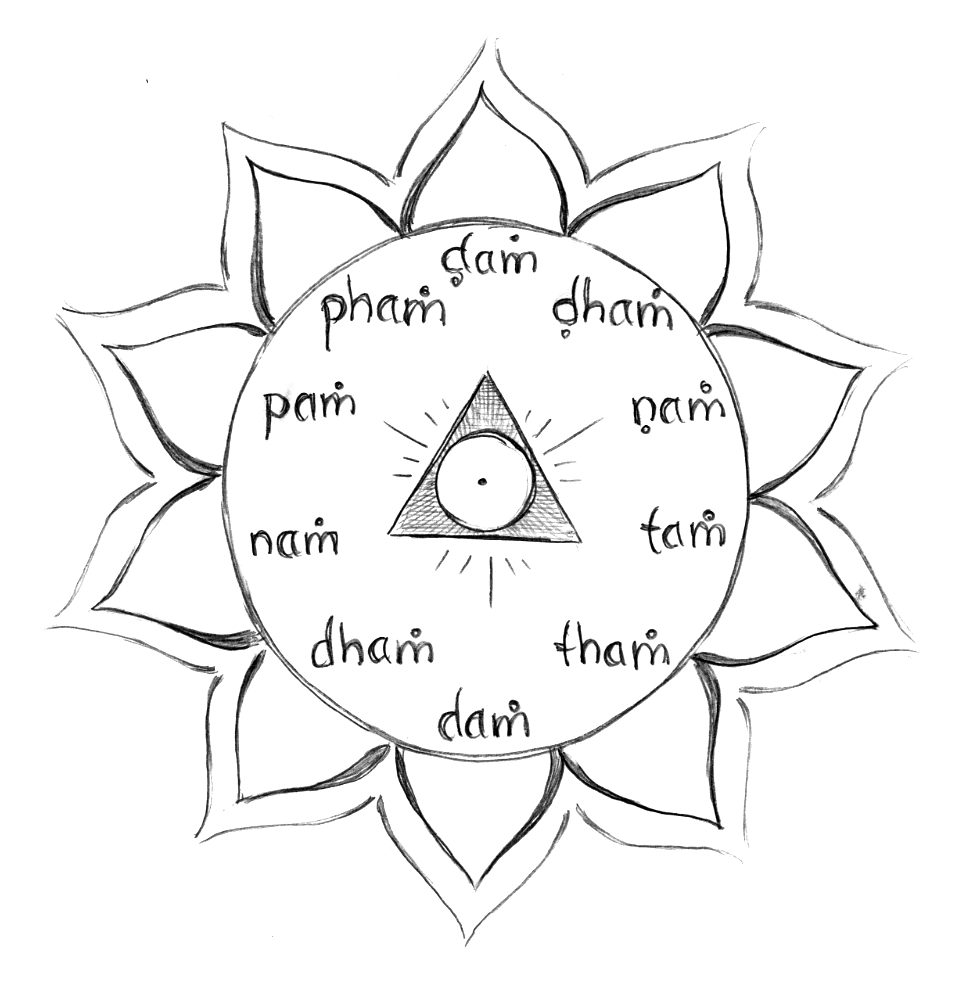
The lotus called Ājñā is like the beautiful white moon. On its two petals are the syllables Ha and Kṣa, which are also white and enhance its beauty.

It radiates with the radiance of meditation (Dhyāna).

Ṣaṭ-Cakra-Nirūpaṇa

Ajna Chakra Sound

THE ENDLESS MYSTERY

Ājñā means “the command” and is the place where the will of reality becomes visible; from there, the world commands its own existence.

It is a place of unity where one’s own will and the will of the world become one. When one’s own will becomes one with that of the world, the path to right living and action becomes clear. The insight into how one should live and act is the ideal—and thus divine—path, and in a certain sense, the divine commandment.

However, this commandment is not one that God demands or pronounces. It is simply the way things are. The world dictates this “way of being.” It is more compelling than any will or desire; what is, is always as it is.

Reality speaks for itself through its very existence; it needs no words.

Ājñā is a state of meditative trance in which one penetrates into absolute emptiness as the source of all existence. This emptiness is ecstatic; it is not only pure emptiness (śūnyatā) but also total fullness (pūrṇatva). By fully embracing that which is nothing at all, what everything truly is becomes visible. For all being is completely contained within non-being.

Only when you are completely still can you truly hear what the world has to say; when you are ready to die, you are ready to truly live.

The deeper one goes into emptiness, the greater the attraction to the highest fullness becomes. These two are connected, for the highest emptiness of the ājñā chakra is underpinned by an almost unbearable intensity of ecstasy. The joy of everything that will ever be, all desires that will ever be felt, all love that seeks to and will give birth to more love—all of this slumbers within the matrix of this supreme emptiness.

This dance—at once empty and full, ecstatic—is the ājñā chakra.

The world is shaped by the interplay of two currents—one that flows downward and one that strives upward. One is iḍā, the nourishing moon that flows down into manifestation, and the other is piṅgalā, the power of the sun that strives upward into the subtle realm. Ājñā is the gateway to these two forces, creation and dissolution. Ājñā is the explosion of all being from a single, dimensionless point (bindu). This explosion—the emergence of all things into being—is the ecstasy of ājñā, an orgasmic joy experienced during meditation on ājñā.

Ājñā is described as Vārāṇasī, or Benares, the city situated between India’s two sacred rivers. These rivers represent the waters of light and darkness that flow down from the sacred mountains. This metaphor stands for iḍā and piṅgalā, the two rivers that flow down from the one suṣumnā— the sacred mountain and central channel of consciousness.

Ājñā lies between these two rivers and is thus the space free from the influences of iḍā (the inner mind) and piṅgalā (outer objectivity). These two forces represent the sensory world, life and death, and all the elements contained within them. Ājñā is thus the place where duality ends— the end of death and also of birth.

When the entire world dissolves into meditation, the Self becomes absorbed in the world. Then the Self dances joyfully away. This meditative absorption in the Ultimate is unity; it is dhyāna. It is the death of what one desires, in order to truly live as what one is.

To be empty of oneself, yet filled with true being.

At the point where the nadis converge at ājñā lies rudragranthi, which is transcended by the power of icchāśakti —the supreme will. Rudragranthi is the place of attachment to the Self. This attachment can only be overcome if its dissolution is an act of joy. How could one ever let go if one did not know that one is held by the hand of God?

Deep down, we know that joy is our true nature. Dissolving into joy and letting go, therefore, means entering into a greater state of being. It is not the destruction of the self; it is its expansion into a greater form. Joy is its home.

Therefore, in the presence of this gift, the limited self dissolves without resistance. This eternal joy is like the cosmic water from which all things spring, and symbolizes the orgasmic source of the world. It is personified by Mahā Lakṣmī, the one and eternal great abundance.
Moon Vishuddha

FEATURES

Active: Joy, knowing the unknown, recognizing the mystery, clairvoyance, ecstasy, indifference to everything. Spontaneous meditation.

Meaning: The command

Mantra: Oṃ, Oṃ Mahālakṣmī namaḥ

Element Bīja: Energy (Haṃ/Kṣaṃ)

Aspect of icchāśakti: Eternal Water— Mahā Lakṣmī

Age: 35–42 years

Anatomy: Behind the eyebrows, in the center of the skull/pituitary gland. Also called bhrūmadhya.

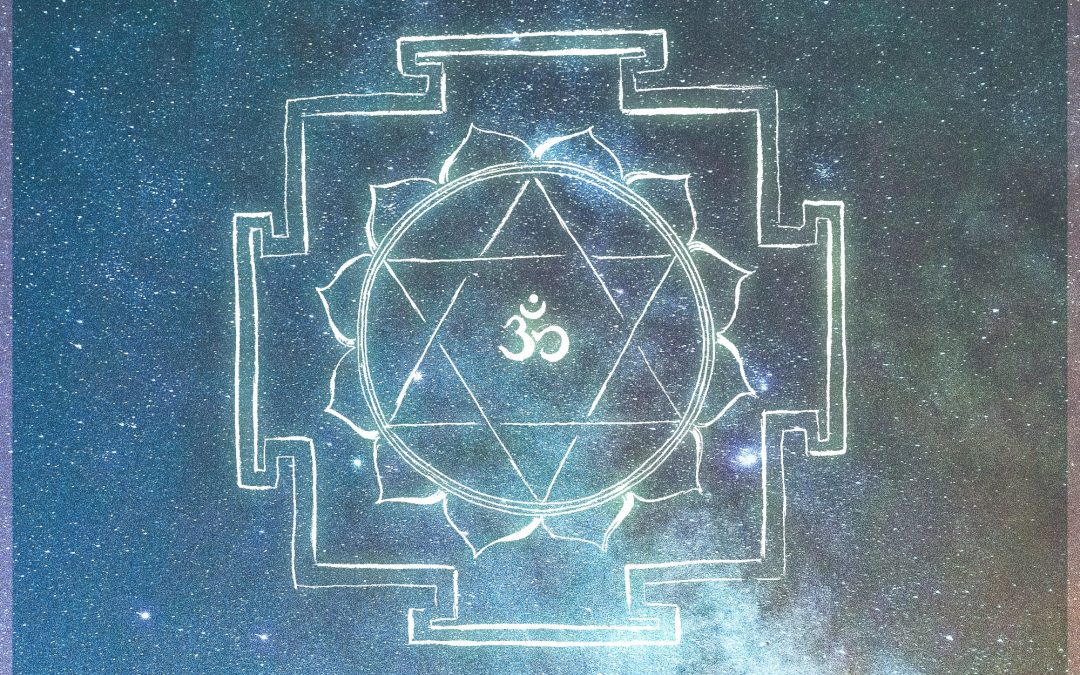
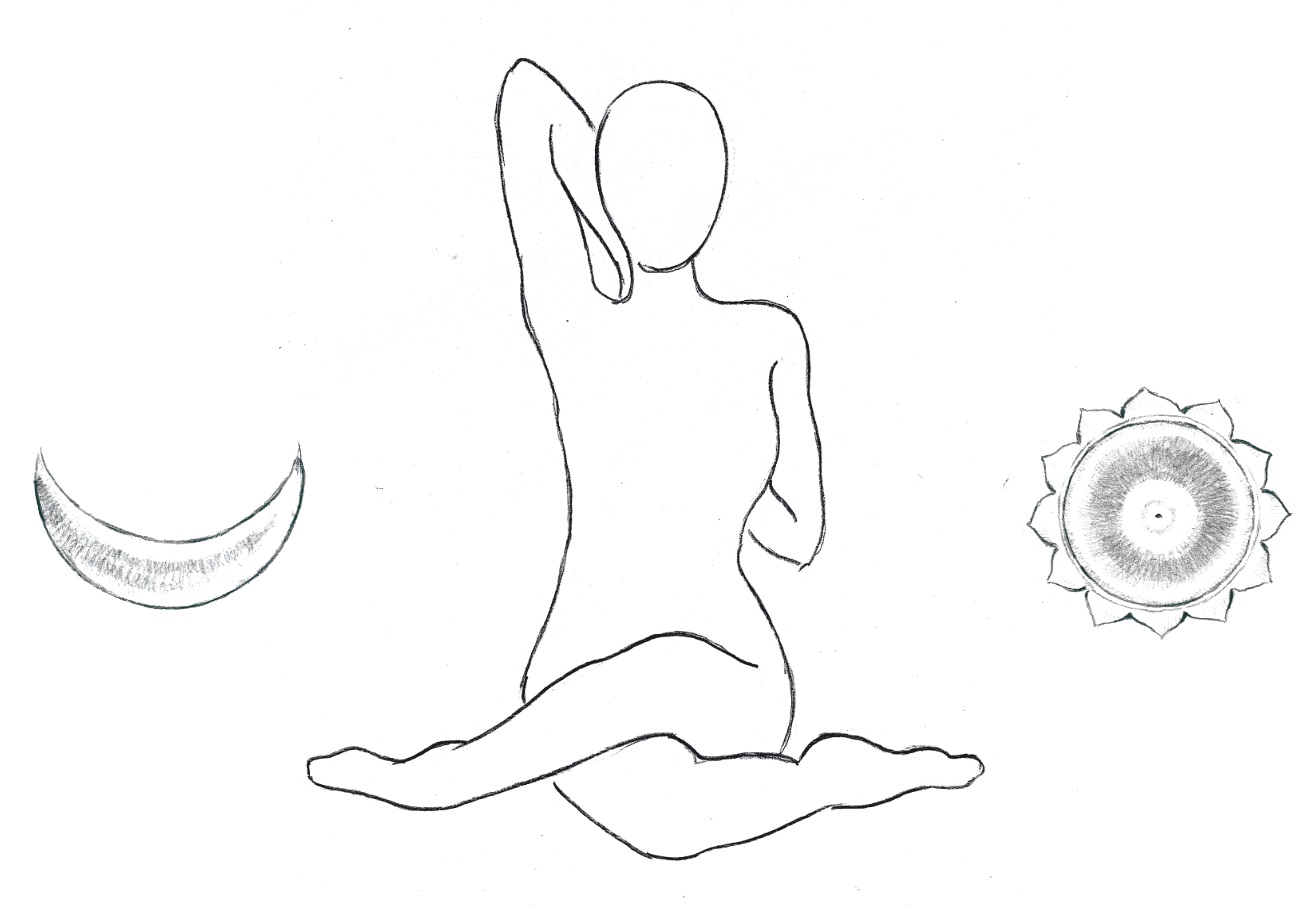
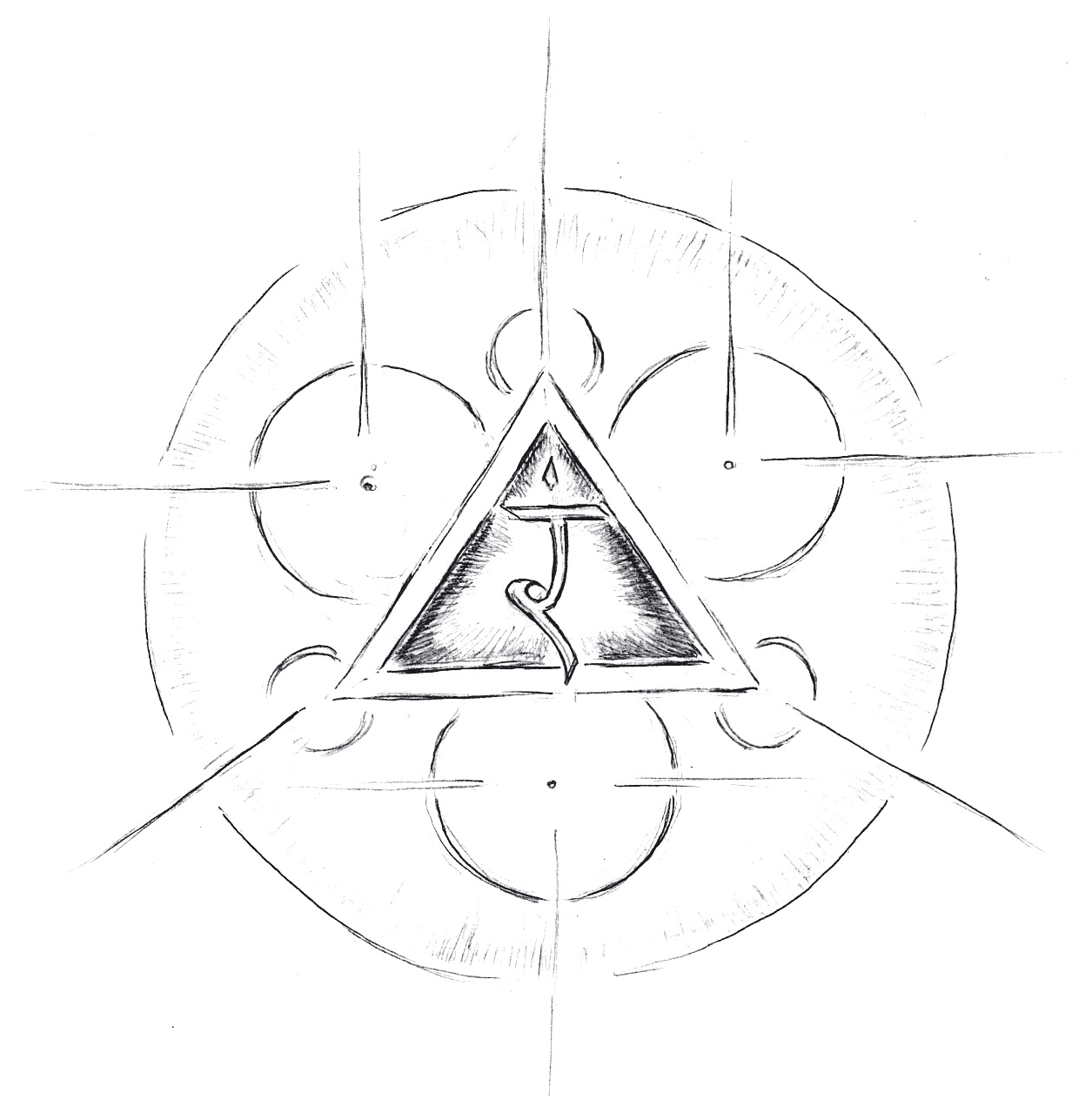
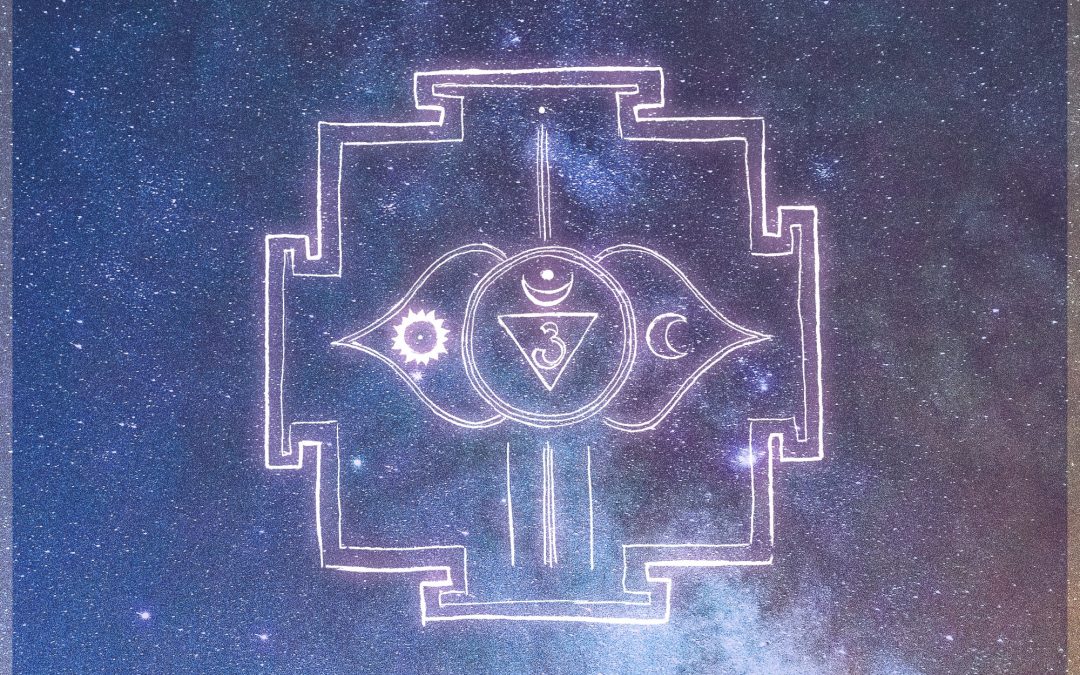
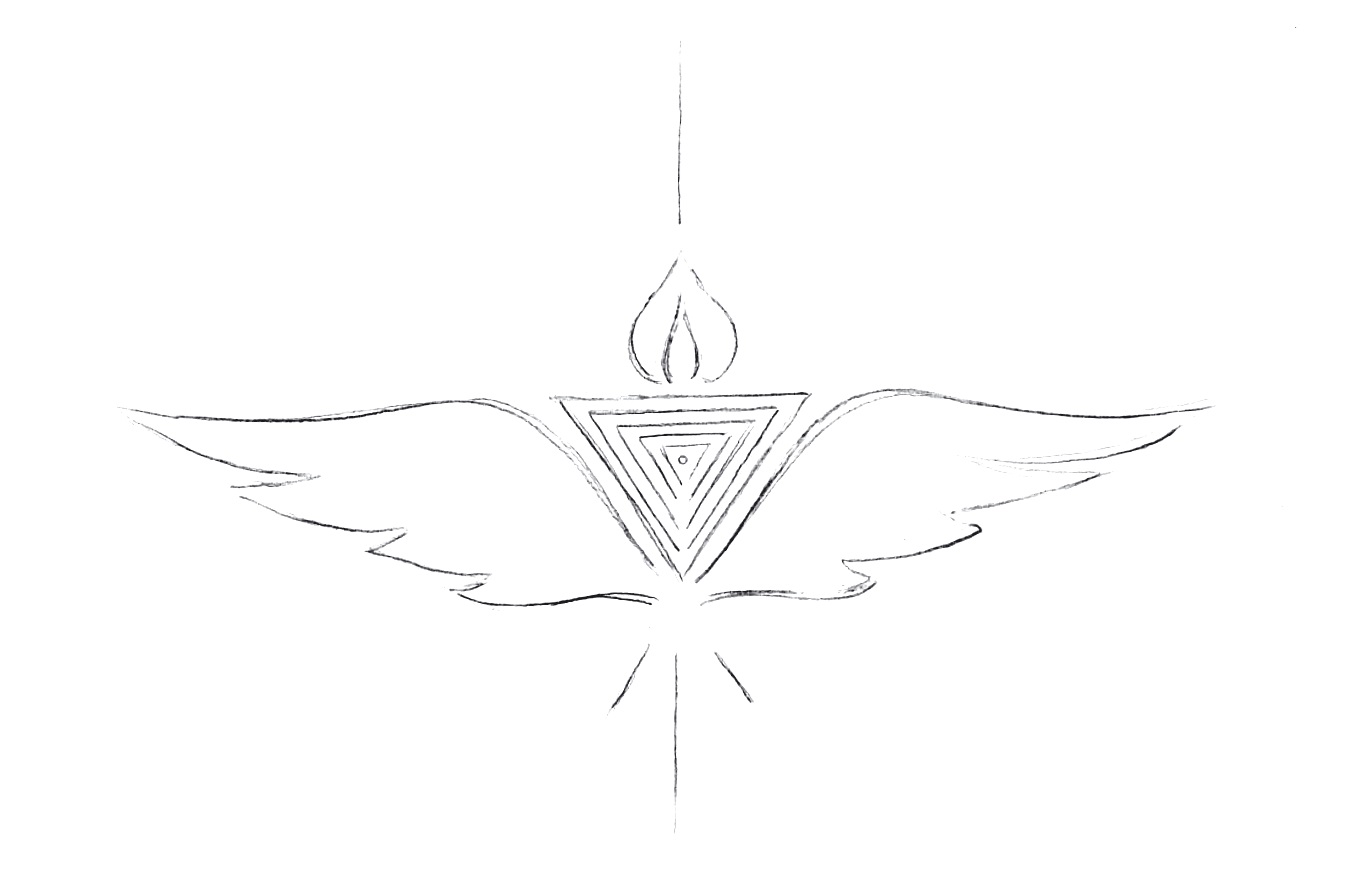
Symbolism: A white lotus with two petals, a silver disc, and a black liṅga.
iccha shakti para

Exercise for the Heart Chakra

Here in our download section, you'll find the "Anahata Kriya" exercise. This exercise is a way to honor and awaken the energy of the heart chakra.

All the exercises are hand-illustrated and lovingly designed. They will enrich and deepen your yoga practice. Come join us and practice with us! All the best!

Learn more about the chakras here

A journey through the chakras is a journey to yourself.

In this book, we also explore the roots of Kundalini Yoga and yogic anatomy, and we discover the secrets of the koshas, prana, and the Trinity of the Goddess.

These profound practices, visions and insights into yogic anatomy and chakras will inspire and enrich any yoga practice.

More Articles Weekly

We'll be posting new articles every week on the individual chakras, the koshas, and topics in yogic philosophy. Stop by or send us an email so I can add you to our newsletter mailing list.

Any questions? Just write to us!

Anahata Chakra

Anahata Chakra

ANĀHATA Chakra

The yogi who listens to the sound within the heart—which is like a rushing river with no beginning and no end—will bathe in this sound, which is one with God (śabda-brahmaṇi), and attain the highest state.

Vijñāna-Bhairava-Tantra (38)


Anahata Chakra Sound

THE Seat of the Soul

From the very center of being, a sound rises—the sound of your existence, the sound of all things. It is the symphony of life, in which every note reflects your suffering, but also your joy.

This music captures the essence of what is; it spans everything from life to death, and from death to eternal existence.

Anāhata, which means “unstruck” or “undefeated,” refers to that which exists without a cause—like the sound of a single clapping hand or the string of a musical instrument that rings out without having been plucked. It is Being that exists of its own accord, without needing any external input. Anāhata lives simply because it has always lived. It is eternal Being, the seat of the soul.

Existence first manifests as a point (bindu) and then as nāda (primordial sound). Anāhata is the place where nāda can be perceived as nāda anāhata (the sound of the heart). This sound has neither beginning nor end. It is a reflection of the Divine and is Oṃ, the eternal sound—the inner mantra of the heart.

This nāda anāhata, or Oṃ, is Śabda-brahman, the Divine in the form of sound. For what is the world but the symphony of God’s body? You yourself are a melody that life composes through you. Brahman, the Divine, is one with ātman, the individual soul. Because of this unity of ātman and Brahman, ātman itself resides in the heart and burns there like a flame that never flickers or smokes. This flame, called akhaṇḍa jyoti, burns like sound, without beginning or end.

What has no end cannot be defeated. It can neither be taken nor given. It exists without any conditions, forever and ever.

This is the source of unconditional love that shines upon the world, regardless of who steps into its light. It is the source of beauty that radiates from the world and dwells in the hearts of all beings.

The heart is that place that lies between heaven and earth. From its center, it looks up into the universe and recognizes its eternal nature, yet at the same time it looks down upon life and recognizes in it the finitude and suffering of all things.

The symphony that resounds from the heart is therefore both tragic and beautiful. Those who enter the space of the heart can feel that sadness which is permeated with joy. Only those who can share in the suffering of others develop compassion. Deep at the core of this compassion lie tears of joy, and a weeping in which joyful beauty resides.

Anāhata is also the seat of vijñānamaya kośa, the body of knowledge. This knowledge differs from that produced by mānas and the senses. Vijñāna (which means consciousness, insight, or discrimination) refers to the knowledge that arises from a state of mindfulness. It is the sum total of all insights one possesses regarding the nature of reality.

Thus, vijñāna encompasses the beliefs one holds about the nature of reality (e.g., that the world is a place to give love or acquire wealth). With regard to the specific form of the personality, this knowledge crystallizes into moral guidelines or religious beliefs. This is where all the deep structures of faith and beliefs about the nature of the divine lie.

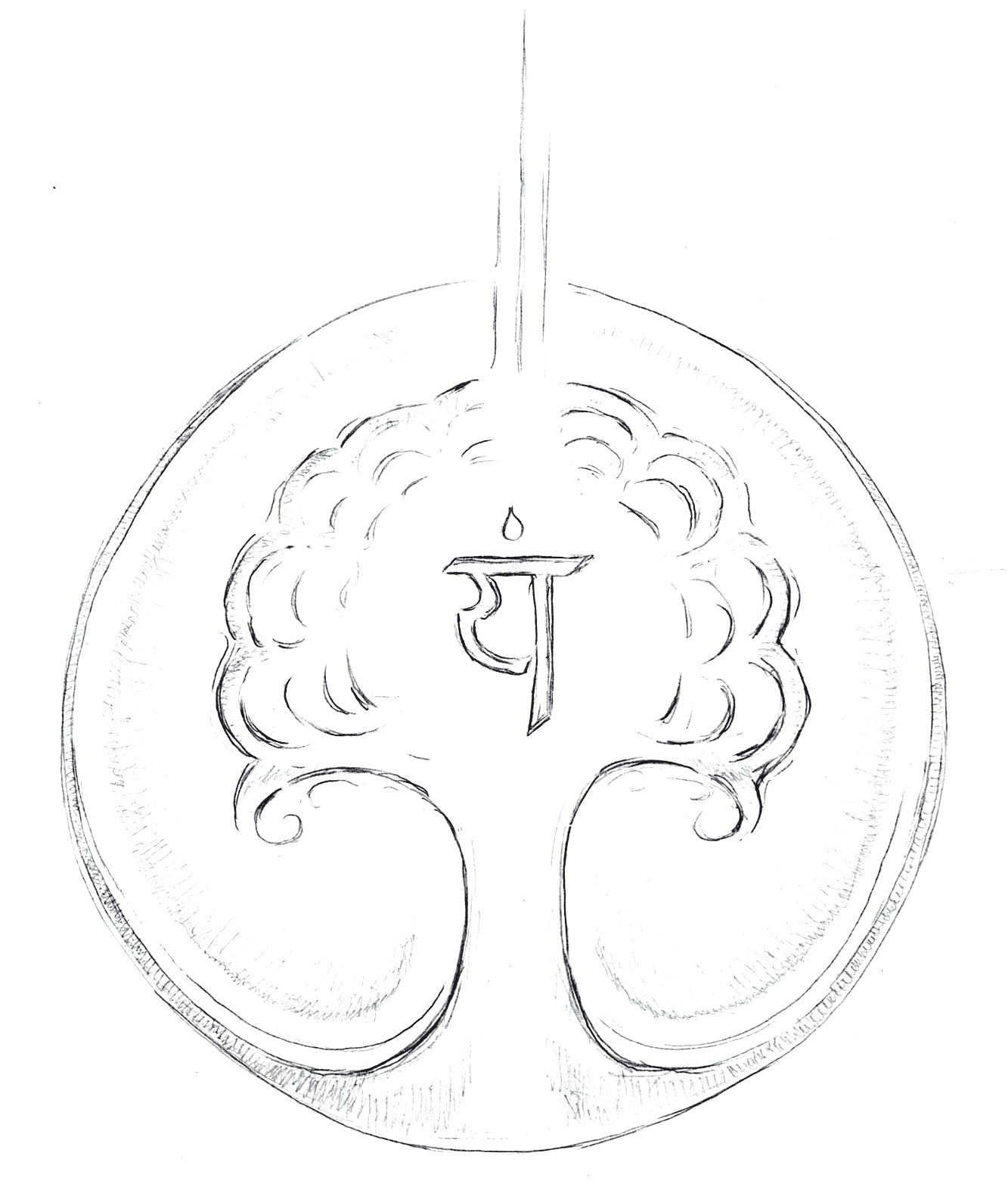
In this way , the kalpataru— the wish-fulfilling tree—grows within anāhata, because every deep belief must become your reality. Thus, reality flows forth from the depths of the heart.
Just as the heart is the seat of vijñānamaya kośa— the body of true knowledge—on the individual level of your being, so too is the heart the seat of jñānaśakti —the power of true insight—on the cosmic level.

Jñāna is true knowledge that transcends personal consciousness, or vijñāna. Related to the Greek word gnō̂sis, it shares the same root and refers to insight into the nature of God.

Jñānaśakti is that cosmic power that knows what is real and can distinguish between falsehood and truth. For the heart knows why life is meaningful, why good is right and evil is wrong.

Jñānaśakti is that inner knowledge in which this truth becomes clear. At the heart of jñānaśakti shines the one cosmic love.

May Parāparā (Jñānaśakti), the pulsating, radiant spark of knowledge that has burned away the threefold bondage with her blazing rays of light, have the power to uproot everything that contradicts the truth.

Tantrāloka (Dr. Mark S. G. Dyczkowski)

Tree of Life Yoga

FEATURES

Balanced:

Knowing God is loving God. Joy, openness, clear and candid speech, creativity, a wordless understanding of the deeper meaning of life, an appreciation for the beauty of life and death, compassion. A willingness to trust and let go. Deep breathing, a long life, and vitality well into old age.

Unbalanced:

Cruelty, nihilism, totalitarian tendencies, arrogance, narrow-mindedness, difficulty opening up to new possibilities. Distrust of others. Shallow or irregular breathing. Short lifespan. Heart problems.

Meaning: The undefeated, the invincible

Mantra: Oṃ vāyu namaḥ, oṃ

Bīja element: Yaṃ, Air

Cosmic Aspect: Jñānaśakti —the Power of True Insight

Age: 21–28 years

Anatomy: At the center of the central vertical axis (suṣumnā). At the center of the chest.

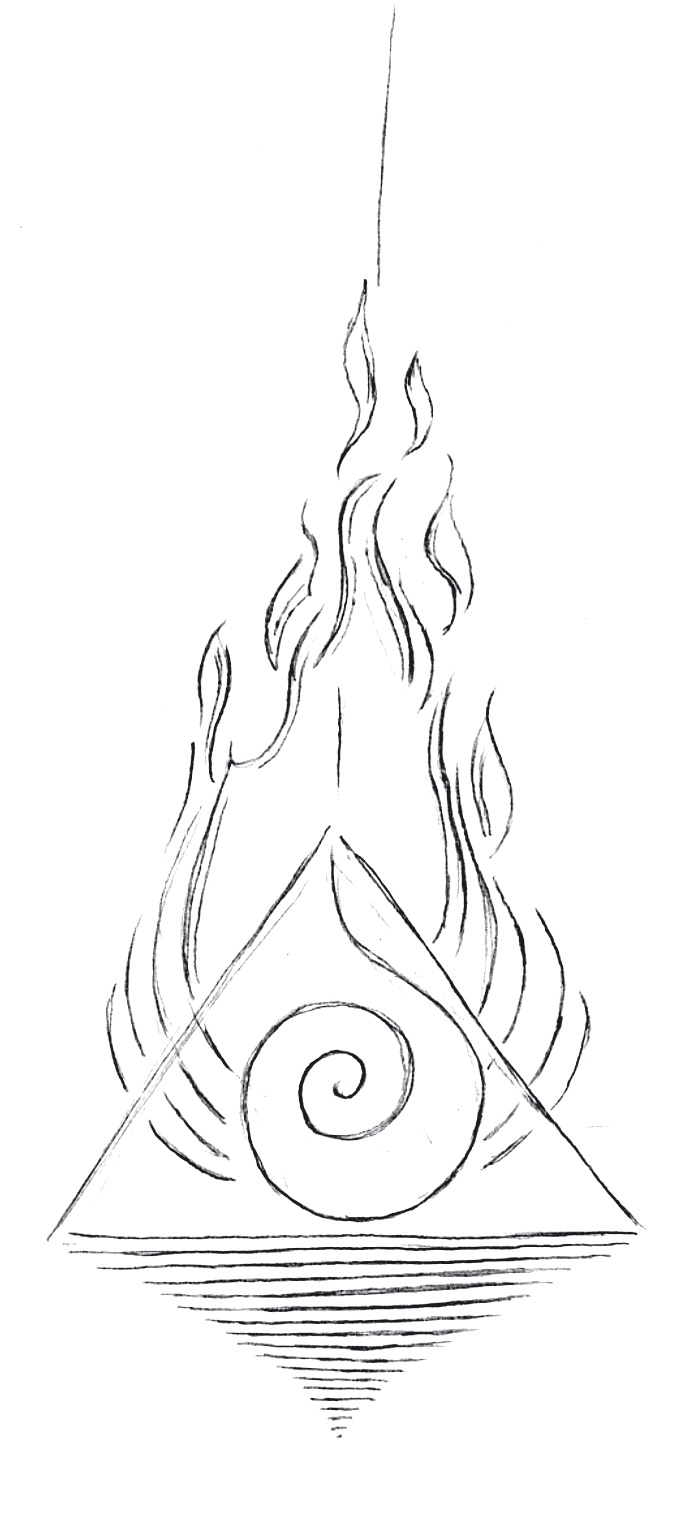
Symbolism: A lotus with 12 petals, two intertwined triangles, a flame without smoke.

Anahata Chakra Yantra

Exercise for the Heart Chakra

Here in our download section, you'll find the "Anahata Kriya" exercise. This exercise is a way to honor and awaken the energy of the heart chakra.

All the exercises are hand-illustrated and lovingly designed. They will enrich and deepen your yoga practice. Come join us and practice with us! All the best!

Learn more about the chakras here

A journey through the chakras is a journey to yourself.

In this book, we also explore the roots of Kundalini Yoga and yogic anatomy, and we discover the secrets of the koshas, prana, and the Trinity of the Goddess.

These profound practices, visions and insights into yogic anatomy and chakras will inspire and enrich any yoga practice.

More Articles Weekly

We'll be posting new articles every week on the individual chakras, the koshas, and topics in yogic philosophy. Stop by or send us an email so I can add you to our newsletter mailing list.

Any questions? Just write to us!

Manipura Chakra

Manipura Chakra

MAṆIPŪRA Chakra

The chakra located in the navel region is called maṇipūraka (house of gems), because the body is permeated by vāyu (prāṇa) like gems strung on a thread.

Driven by past virtuous and sinful karma, the jīva whirls around in this great chakra with twelve spokes until it has grasped the truth.

Dhyānabindhu Upanishad (48–50)

navel chakra, manipura chakra, sound

THE SEAT OF POWER

The maṇipūra chakra, also known as the“House of Crystals,” is the center of self-empowerment and the seat of the waking state of consciousness (jāgrat).

It represents the power of fire and the spirit, which, when transformed, forms the final aspect of kriyāśakti, the universal power of action.

Rising from the depths of desire and the blindness of the lower centers, the awakening maṇipūra enables the practitioner to overcome blind desires and take control of their own destiny. Purposeful action is what the lower centers lack amid the fog of passions; maṇipūra, the fire, is the ability to see. This inner and outer vision enables the mind to choose a path into the future.

Maṇipūra is the seat of the mānas, the mind, and thus the source of the manomaya kośa —the mental body, the seat of our knowledge and our projections.

True reality exists beyond what can be categorized. It is incomprehensible, like a leaf on a tree, a stone, or this book—all these things can indeed be classified into categories, but their true nature goes far beyond that. That which actually is cannot be grasped; it would dissolve our mind. Therefore, in order to function in the world, the mind must carve out a single comprehensible image from the incomprehensible, vast reality.

In this way, with every category, the mind destroys the infinite potential of what is, in favor of a single thing—the cosmic experience in favor of a single human being, which is you.

The mind creates illusions, images, and stories, and leads us to believe that this is the world. If we cling to these images, the world shrinks to the boundaries of those images; the pulsating wonder of the world is lost. For wonder is that which arises anew, beyond comprehension; it unfolds beyond the mind and then presents itself to the mind as a gift.

When the miracle is suffocated by a mere reflection of itself, the world is lost along with it; the mind revolves only around itself and believes it knows the world. And when it looks outward, it sees only its own reflection, the grimace of its illusions. Depression, anger, and fear then take hold.

For when the infinite must give way to the finite, the infinite Self within you becomes trapped in a finite world; then despair is inevitable. Therefore, the mind must be transformed; one must pour it like salt into the sea of infinity, and then the Self will be freed from its prison

For the yogi, the path out of this limitation lies through the mind itself, for the yogi must use the mind to transcend the mind itself. This paradoxical process is the path of śaktopāya, the path of power. The mind, which is the source of binding illusion, possesses the power to create a liberating illusion.

Śakti is both bondage and freedom.

The mind must create an image of the highest reality and then dissolve itself into that image. Concentrating on the highest Self breaks through the barrier of all categories and brings the Self into the meditative state of being—that there is only one great, formless reality. Thus, the mind is liberated and becomes one with the ocean once again.

If you set your mind on me and worship me with all your heart, you will surely come to me; I promise this because I love you.

Bhagavad Gita [18.65]

When one surrenders one’s own mind to the Infinite, all limitations fall away, and the path to the awakening of the ultimate aspect of the universal power of action (kriyāśakti) is opened: īśvara-praṇidhāna—surrender to God.

Surrender to the ocean of the Universal silences the mind and opens it to the beauty of what is now, of what truly is.

Only when the three forces of the lower centers—heat (tapas), the cultivation of mindfulness (svadhyaya), and devotion to God (īśvara-praṇidhāna)—can the Kuṇḍalinī rise through the individual self to the heart.

That is the path to self-realization and, at the same time, the path to becoming a living part of everything.

person meditating, yoga, sun, moon

FEATURES

Balanced:

Willpower, concentration, a sense of freedom and wonder, stillness. Ease in decision-making and action. Acceptance of death. Control over one’s own body. Healthy skin, easy digestion, a strong metabolism, a balanced weight.

Unbalanced:

Weakness of will, mind, and focus. Driven by blind ambition and inner restlessness. Difficulty establishing a sense of self in life. Nervous disposition. Unstable metabolism, underweight. Aggression, digestive pain and problems, inflammatory diseases, skin problems.

Meaning: House of Crystals

Mantra: Oṃ agni namaḥ

Element bīja: Raṃ, fire (agni)

An aspect of kriyāśakti: Īśvara-praṇidhāna – devotion to God

Age: 14–21 years

Anatomy: Located on the central axis behind the navel. The Bihar School specifies its position at the navel.

Symbolism: A lotus with 10 petals, a downward-pointing triangle that shines like the rising sun.

Manipura Chakra, Sun, Power

Exercise for the Navel Chakra

Here in our download section, you'll find the "Manipura Kriya" exercise. This exercise is a way to honor and awaken the energy of the navel chakra.

All the exercises are hand-illustrated and lovingly designed. They will enrich and deepen your yoga practice. Come join us and practice with us! All the best!

Learn more about the chakras here

A journey through the chakras is a journey to yourself.

In this book, we also explore the roots of Kundalini Yoga and yogic anatomy, and we discover the secrets of the koshas, prana, and the Trinity of the Goddess.

These profound practices, visions and insights into yogic anatomy and chakras will inspire and enrich any yoga practice.

More Articles Weekly

We'll be posting new articles every week on the individual chakras, the koshas, and topics in yogic philosophy. Stop by or send us an email so I can add you to our newsletter mailing list.

Any questions? Just write to us!

Svadhistana Chakra

Svadhistana Chakra

SVĀDHIṢṬHĀNA Chakra

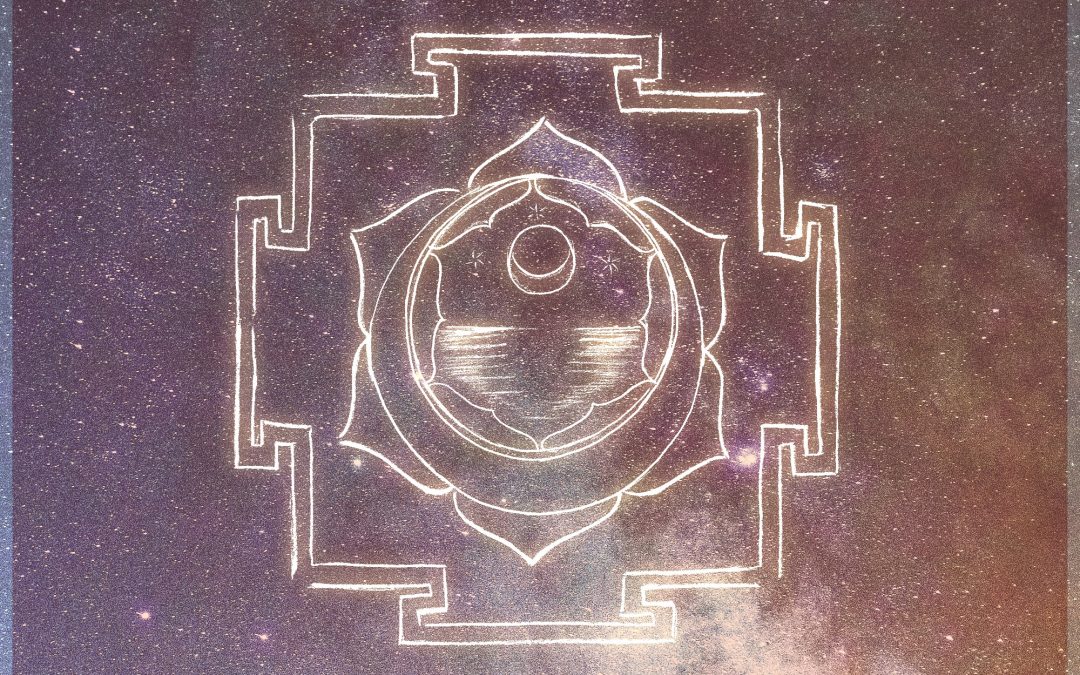
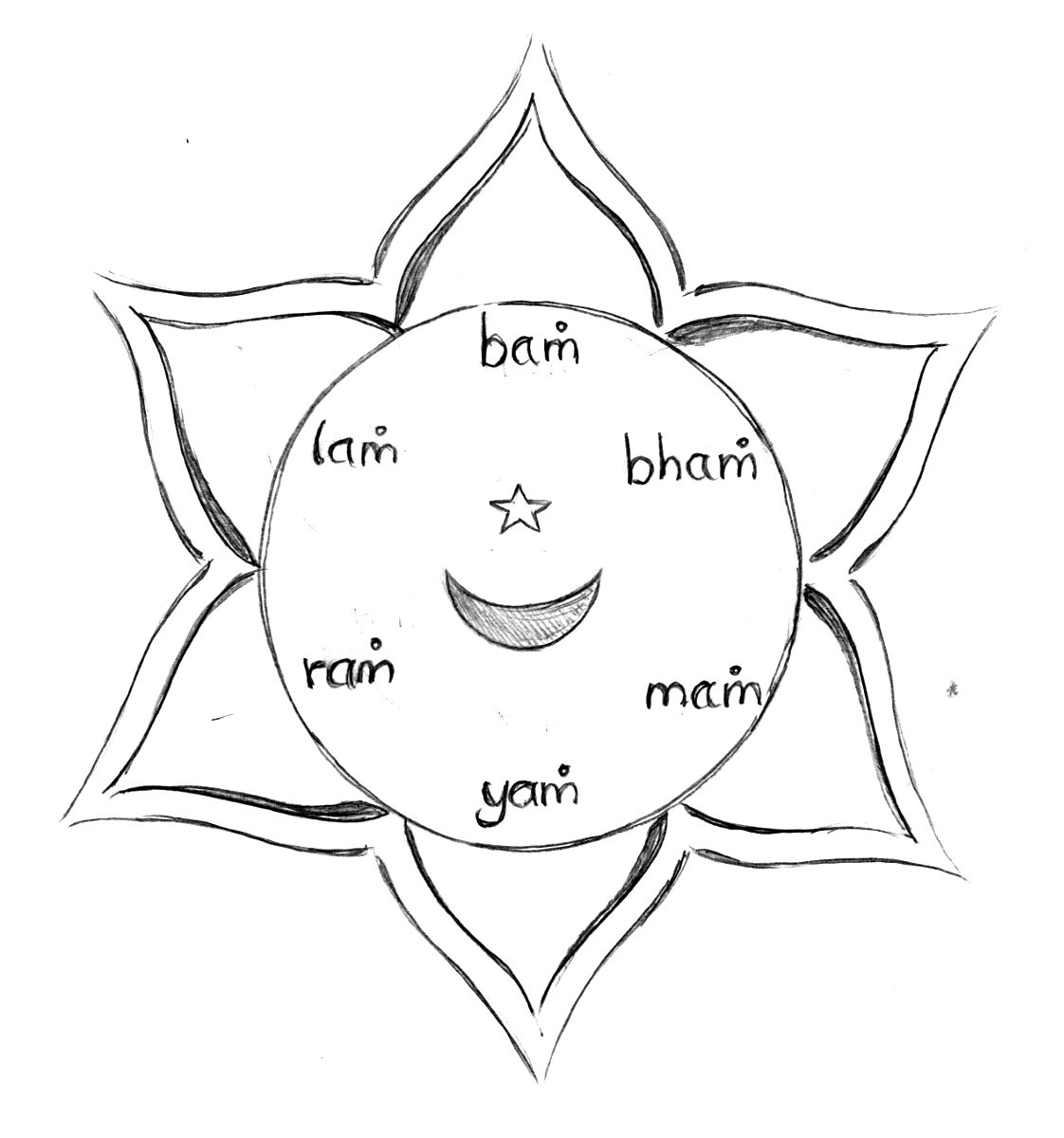
There is another lotus, situated within the suṣumnā at the base of the genitals, of a beautiful scarlet color.

On its six petals are the syllables Ba, Bha, Ma, Ya, Ra, and La, each with a bindu above it, in the brilliant color of lightning.

Ṣaṭ-Cakra-Nirūpaṇa

Svadhisthana Sacral Chakra Sound

THE SEAT OF DESIRE

Svādhiṣṭhāna is the gateway to the world of dreams, where a vast ocean surges, from which our passions arise. It is the awakening from the deep night of dreamless sleep in which the Self was enveloped in the mūlādhāra. Here, the dream reigns, and the darkness of the mūlādhāra is pierced by the light of the crescent moon.

The soft light of the moon glistens on the waves of the ocean of our passions. Mesmerized, we gaze at the water, walk along the beach, and catch our dreams. Each wave washes what lies deep within onto the shores of the outer world. From the spray, the terrifying and the ecstatic rise up. Svādhiṣṭhāna is the infinite sweetness of dreams, the eternal play of children in the garden of perfect innocence—fragile, painful, and yet beautiful.

Svādhiṣṭhāna translates as “one’s own abode” and is the cradle from which our dreams and emotions spring. It embodies the dream state (svapna) and makes reality seem like a dream, full of passion, pain, and joy. These feelings, whether positive or negative in nature, merge with us and shape the “flavor” of our self-experience.

Svādhiṣṭhāna is therefore the seat of the Self, since the Self takes shape through its emotional states even before the mind can form a conceptual identity. Prāṇa is the universal vehicle of experience; it conveys the qualities of what we experience and enriches the universe and our being. Svādhiṣṭhāna is the seat of prāṇa and thus the seat of prāṇāmaya kośa, the vital sheath.

As mentioned in the Taittirīya Upaniṣad (II–2–1), prāṇa is not merely vitality, but the very soul of the physical body, which breathes life into inanimate matter. When prāṇa flows, life exists; when it withdraws, life decays.

The dance of prāṇa is characterized by movement, growth, and decay. Creation and procreation are its creative expressions. However, the power of creation must always dance with death, with which it is inextricably intertwined. This dance propels life forward—toward procreation, sexual desire, and ultimately decay.

In the maelstrom of these passions, the world appears like a dream; through the lens of subjective feelings, the reality of things becomes invisible. This distortion of truth is called ignorance and is the most important characteristic of the svādhiṣṭhāna chakra, the seat of fundamental ignorance or illusion (avidyā).

The distortion of truth in svādhiṣṭhāna leads to the nurturing of self-destructive forces such as lust, greed, delusion, pride, envy, and selfishness, all of which thrive in the shadow of unrecognized passions. According to Pūrṇānanda’s Ṣaṭ-Cakra-Nirūpaṇa, this dream-like state of the self is transcended through careful self-observation—or, in other words, through the practice of cultivating mindfulness.

Through meditation (mindfulness) on our motives, the impulses hidden within them are brought into the light of consciousness and dissolved in that light. In this way, the second aspect of the awakening of universal creative power (kriyāśakti) lies hidden within svādhiṣṭhāna: svadhyaya—the cultivation of mindfulness (self-study).

When svadhyaya is cultivated, our enemies—who lurk in the shadows of our perception—are transformed into forces that empower us to act. The makara, the mystical monster of the seas that wreaks havoc in our inner waters, then becomes a dancing dragon, a bringer of good fortune and freedom.

The difference between those aspects of ourselves that hold us captive and those that set us free often lies simply in the fact that we are aware of the former but not the latter. Svadhyaya brings these shadows into consciousness and transforms the murky waters of the dream state into a fertile source of emotional strength, life, and a new beginning.

Whoever meditates on this flawless lotus, known as svādhiṣṭhāna, is immediately freed from all his enemies, such as desire, greed, delusion, pride, envy, and selfishness.

He becomes a master among yogis and is like the sun that illuminates the dense darkness of ignorance. The richness of his nectar-like words flows in prose and verse through well-reasoned discussions.

Ṣaṭ-Cakra-Nirūpaṇa (18)

person meditating, yoga, sun, moon

FEATURES

Balanced:

Vitality, refined awareness and insight, strong immune system. Sexual potency. Deep, charismatic, and energetic. Balanced emotions and emotional resilience.

Unbalanced:

Weak immune system, physical illnesses, confusion, sexual perversions. Strong emotional reactions. Lack of emotional strength, dependence. Irresponsibility, inability to cope with hostile environments. Exhaustion.

Meaning: Headquarters

Mantra: Oṃ samudrai namaḥ

Element bīja: Vaṃ, water (āpas)

An aspect of kriyāśakti: Svadhyaya – Cultivating Mindfulness (Self-Study)

Age: 7–14 years Anatomy: It is located in the center of the pelvis. The Bihar School of Yoga describes its temple (kṣētraṁ) as being four finger-widths below the navel. Others say it is the pubic bone.

Symbolism: A lotus with six petals, a silver crescent moon

Svadhistana Dream

Exercise for the Sacral Chakra

Here in our download section, you'll find the "Svadhistana Kriya" exercise. This exercise is a way to honor and awaken the energy of the sacral chakra.

All the exercises are hand-illustrated and lovingly designed. They will enrich and deepen your yoga practice. Come join us and practice with us! All the best!

Learn more about the chakras here

A journey through the chakras is a journey to yourself.

In this book, we also explore the roots of Kundalini Yoga and yogic anatomy, and we discover the secrets of the koshas, prana, and the Trinity of the Goddess.

These profound practices, visions and insights into yogic anatomy and chakras will inspire and enrich any yoga practice.

More Articles Weekly

We'll be posting new articles every week on the individual chakras, the koshas, and topics in yogic philosophy. Stop by or send us an email so I can add you to our newsletter mailing list.

Any questions? Just write to us!

Muladhara Chakra

Muladhara Chakra

MŪLĀDHĀRA Chakra

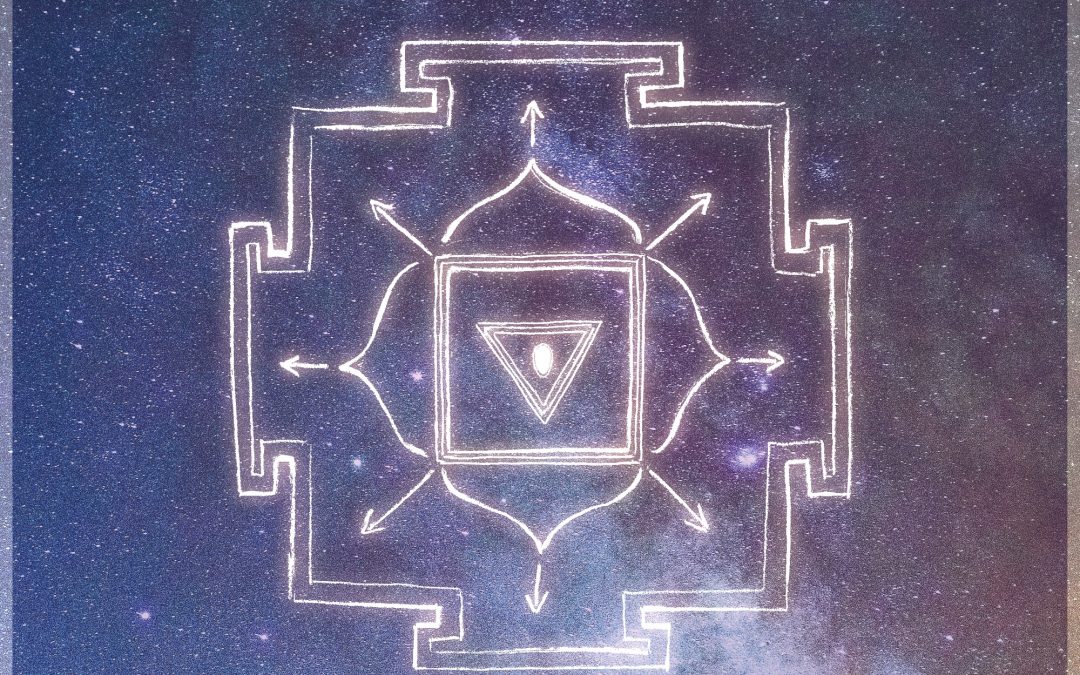
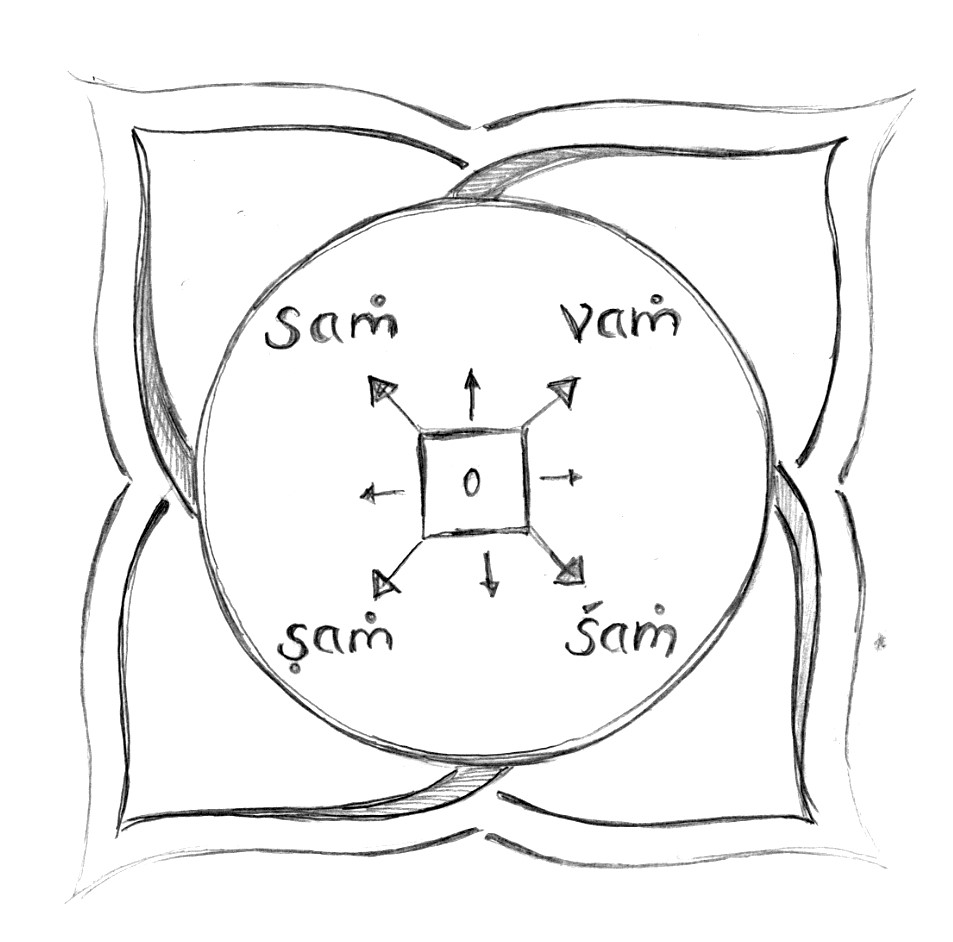
Now we come to the adhara lotus. It is attached to the mouth of the suṣumnā and is located below the genitals and above the anus.

It has four purple petals. Its head (opening) faces downward. The four syllables from Va to Sa are inscribed in shiny gold on its petals.

Within this lotus lies the Square of the Earth, surrounded by eight shining spears. It is a brilliant yellow color and as beautiful as a flash of lightning, just like the bīja of dhāra (Laṃ) that shines within it.

Ṣaṭ-Cakra-Nirūpaṇa

Mualdhara Chakra Sound

THE PLACE WHERE IT ALL BEGAN

The mūlādhāra chakra is the seat of the power that forms the foundation of existence.

It is the gateway to embodiment and, at the same time, to the limitations of being. Here Kuṇḍalinī rests, coiled within itself and asleep, ready to awaken.

Tantra teaches that the union of the three states of consciousness—waking, dreaming, and deep sleep (jāgrat, svapna, suṣupta) —ignites the fire of the Kuṇḍalinī, which ultimately leads to the awakening of the fourth state of consciousness, turīya.

Of these three states, mūlādhāra represents the deep sleep of consciousness, in which the Self is completely immersed in the material world. In deep sleep, suṣupta, consciousness is shrouded in darkness and has no insight into the true nature of things.

This darkness, however, is not without acceptance—it is complete surrender to what is, even if it means limitation. Therefore, this state of being is similar to the supreme bliss of samādhi, yet without the light of consciousness and thus without the realization of it.

Mūlādhāra is thus the deepest, innermost, and most unconscious center—the seat of matter itself, the foundation of all physical and bodily existence, and therefore the anamaya kośa—the physical sheath. Within the trinity of will, knowledge, and action, the physical body is the seat of the first aspect of the power of action (kriyāśakti).

Every action must first be anchored in the body; from there, it makes its way through space and time and shapes the experiences of the self.
The full unfolding of this universal power of action requires the unification of its three components, which correspond to the states of consciousness mentioned and the first three chakras.

The goal of all yogic efforts is to awaken these three aspects in the lower centers and raise their energy to the heart.
The first aspect of kriyāśakti that must be awakened in the mūlādhāra is tapas—the heat or fiery passion for growth, love for the practice, unwavering discipline, and devotion to the power. This aspect of heat, which can overcome the tamasic darkness of the mūlādhāra, marks the first step in the ascent of the Kuṇḍalinī.

Tapas, which is of central importance in yoga, is mentioned right at the beginning of the second chapter of the Yoga Sutras. It is the path to purifying the body and awakening the radiant mūlādhāra.

Yoga of Action (Kriya Yoga) has three components:
Tapas—heat or intense discipline,
Svadhyaya – refinement (self-study),
Ishvara Pranidhana – devotion to God.

Since intense discipline burns away impurities,
the body and its senses become extremely refined.

Pātañjala's Yoga Sutras II (1.43)


person meditating, yoga, sun, moon

FEATURES

Balanced:

A strong, well-built body. Discipline, clear thinking, and good sleep. Easy and healthy elimination. Simple, straightforward thinking; avoiding unproductive thoughts and unnecessary actions. Acceptance of existence and its limitations, as well as its inherent suffering. A sense of security. Fearlessness even in the face of the horrors of existence.

Unbalanced:

Obesity, signs of physical impurity. Difficulty establishing eating, work, and sleep routines. Restless sleep and lethargy. Unnecessary physical movements. Fear of death. Physical weakness.

Meaning: Root, Support
Mantra: Oṃ pṛthvī namaḥ
Element bīja: Laṃ, Earth
Aspect of kriyāśakti: Tapas—heat, intense discipline
Age: 0–7 years

Anatomy: The lower end of the suṣumnā. For women—at the cervix, the inner end of the vagina. For men—halfway between the anus and the genitals, on the perineum.
Symbolism: A four-petaled lotus, a yellow square

Exercise for the Root Chakra

Here in our download section, you'll find the "Muladhara Kriya" exercise. This exercise is a way to honor and awaken the energy of the root chakra.

All the exercises are hand-illustrated and lovingly designed. They will enrich and deepen your yoga practice. Come join us and practice with us! All the best!

Learn more about the chakras here

A journey through the chakras is a journey to yourself.

In this book, we also explore the roots of Kundalini Yoga and yogic anatomy, and we discover the secrets of the koshas, prana, and the Trinity of the Goddess.

These profound practices, visions and insights into yogic anatomy and chakras will inspire and enrich any yoga practice.

More Articles Weekly

We'll be posting new articles every week on the individual chakras, the koshas, and topics in yogic philosophy. Stop by or send us an email so I can add you to our newsletter mailing list.

Any questions? Just write to us!

The Trinity in Yoga

The Trinity in Yoga

THE TRINITY

The triune goddess creates the threefold world in a single, fleeting moment.

O Lord of the Gods, the three gods—Brahmā, Viṣṇu, and Rudra—and the three sacred thrones are created together in the place where the one Lady of the Gods dwells through her threefold nature.

She created this entire universe of animate and inanimate things. She brings about the manifestation and dissolution of all things, solely for the pleasure of the play of being. She creates the threefold universe, the incredible City of the Triangle.

Manthāna Bhairava Tantra (35:14cd-16-17)

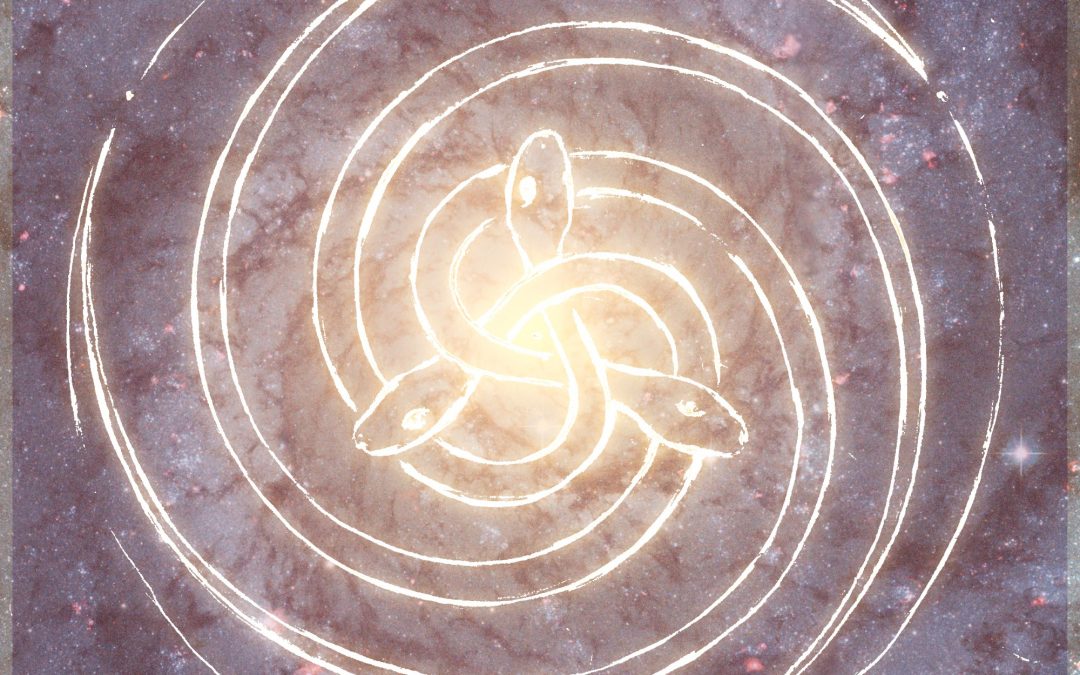
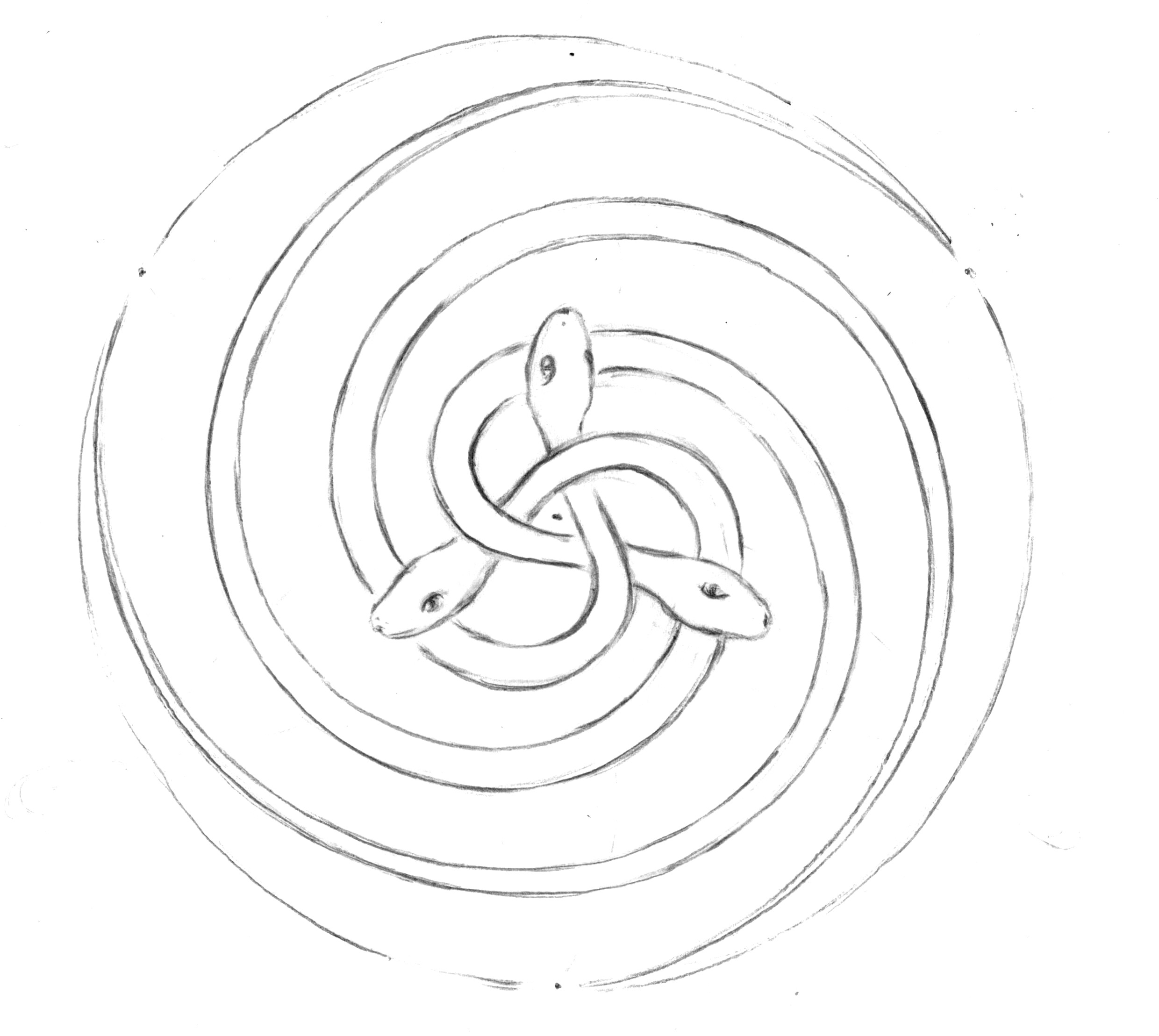
snakes trinity kundalini drawing

PARĀ, PARĀPARĀ, AND APARĀ

Manifestation

In yogic philosophy, the world is viewed as a manifestation of unchanging and eternal principles. These universal principles exist in their highest form beyond all manifestation. As soon as they enter the process of manifestation, they take on form and come into existence; yet, at the very same moment, this process robs them of their eternal nature.

For example, Śiva and Śakti are seen as the two forces that give rise to the universe and its trinity. They are consciousness and its creative power. Their union brings about the birth of all things.

The duality of life—as seen in men and women, who, through the interplay of their natures, give rise to humanity—is an expression of these universal creative forces. We also find this duality in the interplay of the sun and the moon, day and night, and life and death.

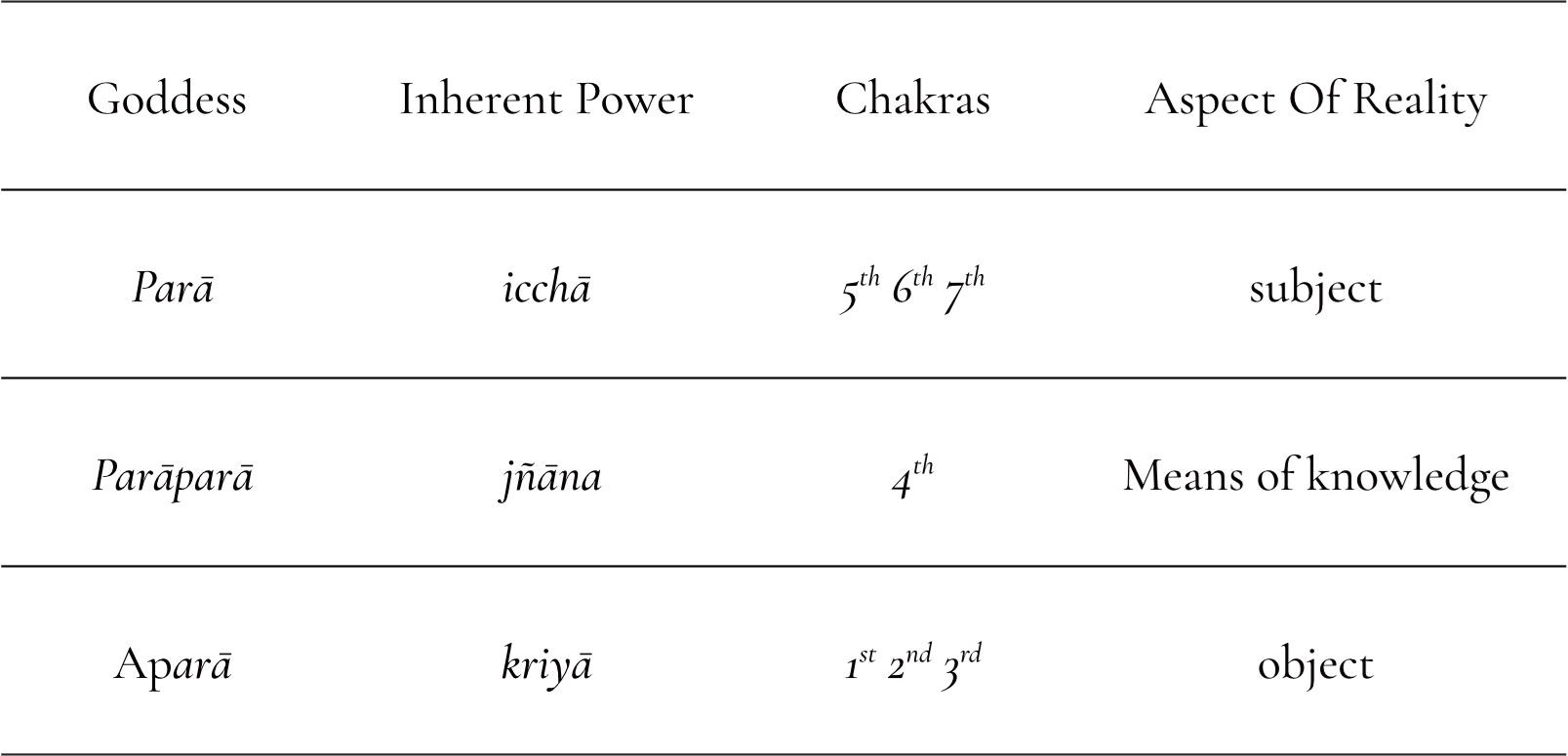
That which is the very essence of all beings and which itself always remains formless is called parā, while that which manifests itself is called aparā. These two aspects can be understood as the Pure (parā) and the Impure (aparā).

Parā is the will to be (icchā śakti) and, in essence, the Self.

Aparā, on the other hand, is the power that creates the manifested world, the power that makes expression possible, and it is at the source of every action (kriyā śakti).

In line with this understanding, the lower chakras are referred to as aparā, for they are the places where consciousness is bound to the finite. At the same time, they are the places from which action arises and through which self-awareness is made possible.

The higher chakras are regarded as parā, since they are the seat of the consciousness that corresponds to the quest for self-knowledge and liberation. In between lies the heart, the goddess Parāparā, who serves as a bridge between the higher and the lower and represents the power of knowledge (jñāna śakti).

Jñāna is the knowledge that can grasp the true nature of things.
This cosmic dance, which is also reflected within the individual, is the interplay of these three fundamental forces that give rise to all of existence, extending beyond the individual.

These three forces also constitute the Trinity that nearly all spiritual traditions have sought throughout the centuries. The Christian tradition, for example, views the world as permeated by the Holy Spirit, the Father, and the Son. Here, the Holy Spirit represents the unmanifested source of being; the Father is the Law and thus the knowledge of truth; and the Son is the embodiment, the power of action, and, ultimately, the experience of God in person.

This trinity is also reflected in the trinity of Brahmā, Viṣṇu, and Śiva: creation, preservation, and unmanifested destruction. It symbolizes the trinity behind will, knowledge, and action—or subject (parā), object (aparā), and means of cognition (parāparā).

The Trinity of Consciousness

The individual self exists on the level of aparā, since that is where the forces of action and self-realization operate. The individual is therefore that aspect of our cosmic self that is sustained by kriyā śakti, the power of action. On this level, the individual self, in turn, manifests in a threefold nature.

The world, much like a hologram, seems to reflect the greater within the smaller. These three components of kriyā śakti are fundamental aspects of human nature from which individual perception and shaping of the world arise—they are three states of human consciousness.

These three states of consciousness that constitute human experience are wakefulness, dreaming, and deep sleep (jāgrat, svapna, suṣupta).

The interplay of these fundamental aspects of consciousness creates the everyday mental state of our being. The interpenetration of these three states forms the foundation of our human self and our actions. The state of consciousness that enables insight into the actual truth of “what is” is a further, fourth state of consciousness.

This fourth state is called turya. In this state, consciousness rises from the lower three chakras to the heart, where it can come into contact with what actually is. Turya, unlike the other three states of consciousness, is therefore the bridge to reality and, at the same time, the meditative state of the mind.

The Trinity of the Goddess

KRIYĀ OR APARĀ ŚAKTI

I bow to the goddess (Aparā), who dwells within Bhairava’s dancing form and plays within him like a flash of lightning against a sky covered with thick storm clouds.

Tantrāloka (Dr. Mark S. G. Dyczkowski)

When we look at the lower three chakras, we see that together they encompass the forces of action: body, vitality, and mind.

These forces of action are governed by the three states of consciousness that encompass human life.

Suṣupti

Mūlādhāra, the first and lowest chakra, contains that aspect of the power of action which is complete immersion and fusion with the physical body.

This state corresponds to the deep sleep of consciousness—Suṣupti. Just as the body itself appears as unconscious matter that is nonetheless permeated by Being, so too, in the state of deep sleep, conscious Being merges completely with unconscious matter. This is where embodiment takes place, and in this way the foundation for every action is laid.

Svapna

The second chakra holds the power of the dream state—Svapna—in which the self exists in the form of desires and dreams. In the dream state, the Self clings to what is pleasant and flees from what is painful. In this state, the Self lacks conscious, deliberate will or control over its own actions.

And yet, it is in these dreams that the treasure of our creative impulses lies hidden; it is here that the world and its dance are dreamed into existence. Svādhiṣṭhāna is the seat of the body of prāṇā, from which life springs forth and fertilizes the world.

Jāgrat

The third aspect of kriyā śakti is the maṇipūra chakra, which is obscured by the storm clouds of one’s own thoughts—it is the seat of the mind. Maṇipūra represents the awakened state of the Self—Jāgrat.

Here, the individual forms ideas about themselves, the future, and the past, and creates their identity. This chakra is therefore the seat of the personality, since an identity can be formed through the images of the mind. However, it is also the place where the goals for our spiritual growth can be formed and set.

Turya

Once these three chakras and their powers have been awakened, they can unite in a meditative state, and the self, with all its passions, can be guided into the heart.

When the heart is reached in the stillness of contemplation, Kuṇḍalinī can be awakened in the form of a flash of lightning, and the path to heaven is clear.

apara shakti kriya shakti

JÑĀNA OR PARĀPARĀ ŚAKTI

May Parāparā, the vibrant, radiant pinnacle of knowledge, who has burned away the threefold bondage with her blazing rays of light, have the power to uproot everything that runs counter to the truth.

Tantrāloka (Dr. Mark S. G. Dyczkowski)

The heart is the seat of Parāparā Śakti, that power which mediates between the supreme parā and the finite aparā, much like the soul, which stands between the earthly and the divine and brings both into harmony through the heart’s decisions.

Parāparā embodies the power of insight, jñāna śakti.

This power holds the key to distinguishing between truth and falsehood. In this way, Parāparā burns away the illusions created by the mind.

Parāparā is the knowledge that lies beyond the conceptual. How do we know what is good or true? We know it because the heart recognizes it and shows us the way, even when there are no words to describe it.

jnana shakti parapara

ICCHĀ OR PARĀ ŚAKTI

I bow to Parā, the creative intuition of consciousness. United with Bhairava, she takes her place atop the lotuses of the Trika trident, whose prongs are the aspects of perception, subject, object, and means of knowledge.

Tantrāloka (Dr. Mark S. G. Dyczkowski)

When the heart has burned away the threefold bondage of illusion, one enters the world ruled by the great power of icchā śakti. This entry is understood as the meditative state of mind in which the heavens open to “What Is” and the mystery of existence is revealed.

It is said that the activity of the higher chakras reflects the functions of the lower chakras. In this sense, icchā śakti just like kriyā śakti— is also divided into three aspects. Each of the upper three centers then reflects a transformed and eternal aspect of one of the lower three chakras.

Viśuddha Chakra

The spirit dwelling within the maṇipūra strives for dominance, for victory over obstacles, and thus for power over the world.

In contrast, the fifth chakra, Viśuddha, means gaining power over the world through power over oneself. Ultimately, there is only one true adversary, who lies within, and no external victory can grant us power over this inner adversary.

Viśuddha represents abundance, fulfillment, strength, and serenity of one’s own being. It is the first aspect of icchā śakti, the energy of transformation of the maṇipūra. Viśuddha is the cosmic nectar—often symbolized as a drop—that is experienced when the mind fully embraces the beauty of reality, beyond all fear.

Isn't it often the case that the mind denies us the pleasure of the world precisely because of its beauty? The more beautiful something is, the greater the fear of losing it.

Only a transformed mind can endure this beauty that transcends all boundaries. This transformed mind is Mahā Kālī, the great and eternal cosmic fire.

ājñā Chakra

The Svādhiṣṭhāna Chakra is the seat of the creative impulse, as well as of attachment to pleasure and the simultaneous aversion to pain. The pure form of this creative impulse must therefore be eternal creation and boundless joy. These qualities of ecstasy are embodied in the ājñā Chakra, the point where the two streams of life meet, symbolizing the forces of cosmic creation.

The second aspect of icchā śakti is thus ājñā, the transformed eternal water. This power is symbolized by the goddess Mahā Lakṣmī, the supreme and never-ending abundance.

Sahasrara Chakra

Sahasrāra is the final aspect of icchā śakti. It is the seat of formless and timeless existence, which, because it has no form, knows no end and is therefore immortal.

This chakra is the transformed state of mūlādhāra, which represents limited existence in form—an existence that, because it is bound by form and time, is mortal and impermanent.

Isn't samādhi—the state that the sages of the East describe as the fully awakened state of sahasrāra—essentially the stillness of deep sleep, but in a state of complete awakening?

Doesn't that mean that life as experienced from the consciousness of the mūlādhāra resembles samādhi, but without insight into its unbound beauty?

Perhaps we go through life only to return to the beginning of the journey with fresh eyes and finally rediscover the true essence of the old places.


iccha shakti para

THE TRANSFORMATION

Taking the above into consideration, the purpose of Kuṇḍalinī Yoga is to activate the energies of the lower chakras, which are governed by aparā, and to transform them into their higher forms, parā.

This process of transformation occurs naturally when the heart is recognized as the gateway from the immanent to the transcendent, and one practices in this way from the heart.

When the mind and body are purified through the power of yoga practice, the qualities of the higher chakras can be developed. All the fundamental practices of Hatha Yoga—such as āsana, prāṇāyāma, and dhāraṇā —are essentially based on this principle.

Āsana, Prāṇāyāma, Dhāraṇā

The practice of āsana focuses on the transformation of the mūlādhāra chakra and the deep state of sleep within it. Through āsana, the body is purified, which simultaneously enables freedom from physical limitations.

Prāṇāyāma purifies the svādhiṣṭhāna chakra, the dream state of consciousness, and enables the yogi to be free from illness and destructive passions.

Dhāraṇā purifies the maṇipūra chakra, the waking state of the mind, and leads to mastery of the mind through the clarification of thoughts.

Swami-ji once told me:

The higher chakras, Parā, are like the summit of a mountain, frozen in ice. When the fire of the lower centers burns strongly because they have been purified, the ice can melt and their awakening can occur.

Svāmī-jī Vidyānand

Chakra Transformation Kundalini Yoga

Learn more about the chakras here

A journey through the chakras is a journey to yourself.

In this book, we also explore the roots of Kundalini Yoga and yogic anatomy, and we discover the secrets of the koshas, prana, and the Trinity of the Goddess.

These profound practices, visions and insights into yogic anatomy and chakras will inspire and enrich any yoga practice.

More Articles Weekly

We'll be posting new articles every week on the individual chakras, the koshas, and topics in yogic philosophy. Stop by or send us an email so I can add you to our newsletter mailing list.

Any questions? Just write to us!