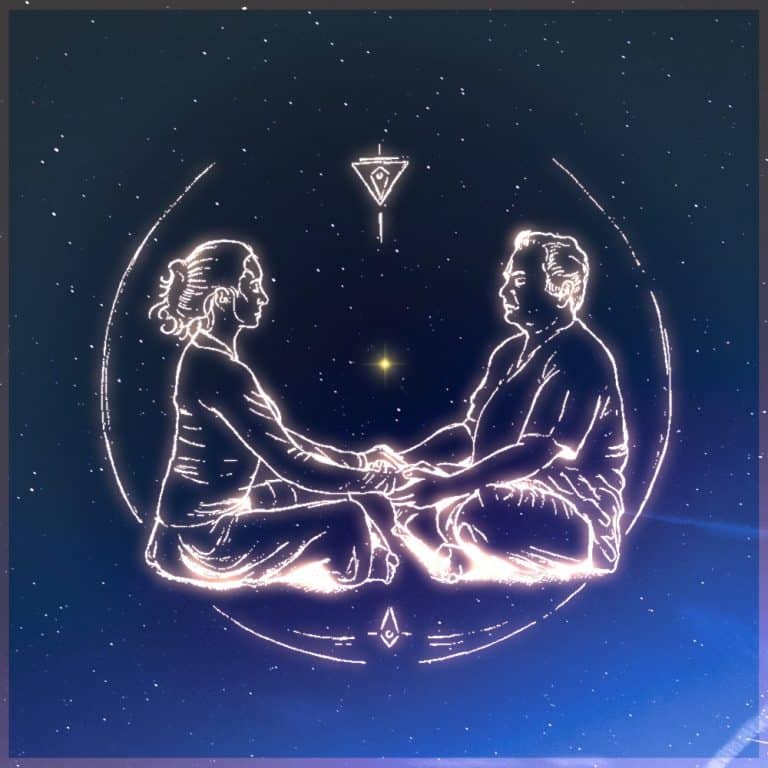
The Post-Classical Era: Matsyendra and Gorakṣa
Beginning around 800 CE, Muslim armies advanced eastward from Persia and eventually established the Great Sultanate of Delhi in 1206 CE. Tantra, which had been widespread and institutionalized during the classical era, was driven into the forests and rural areas, and the number of practitioners declined rapidly.
It is believed today that the loss of institutional support for Tantra weakened its philosophical foundation and in this way led to its transformation into the modern-day Hatha and Kundalini yoga led. Originating in the Kashmir Valley, where Tantra first emerged, it spread southward, where some of its teachings were preserved.

The bridge between Tantra and Hatha Yoga
The connection between Hatha Yoga and Tantra is clarified by a 10th-century master: Matsyendra Nātha. He founded the Kaula lineage of Tantra, and his disciple Gorakṣa is credited with founding Hatha Yoga.
Matsyendra is one of the navnāth, the nine masters of the nāth lineage. He is often portrayed as a fallen hero, entangled in tantric hedonism, which his disciple Gorakṣa sought to transform through the purity of hatha. However, he is also often regarded as the luminous master who triumphs over illusion—māyā pati dādā, the father of fathers. If Gorakṣa is considered the father of Hatha Yoga, then Matsyendra can be regarded as its grandfather.
How this connection manifests itself in our specific practical experience, we describe on our website about Hatha and Kundalini Yoga.
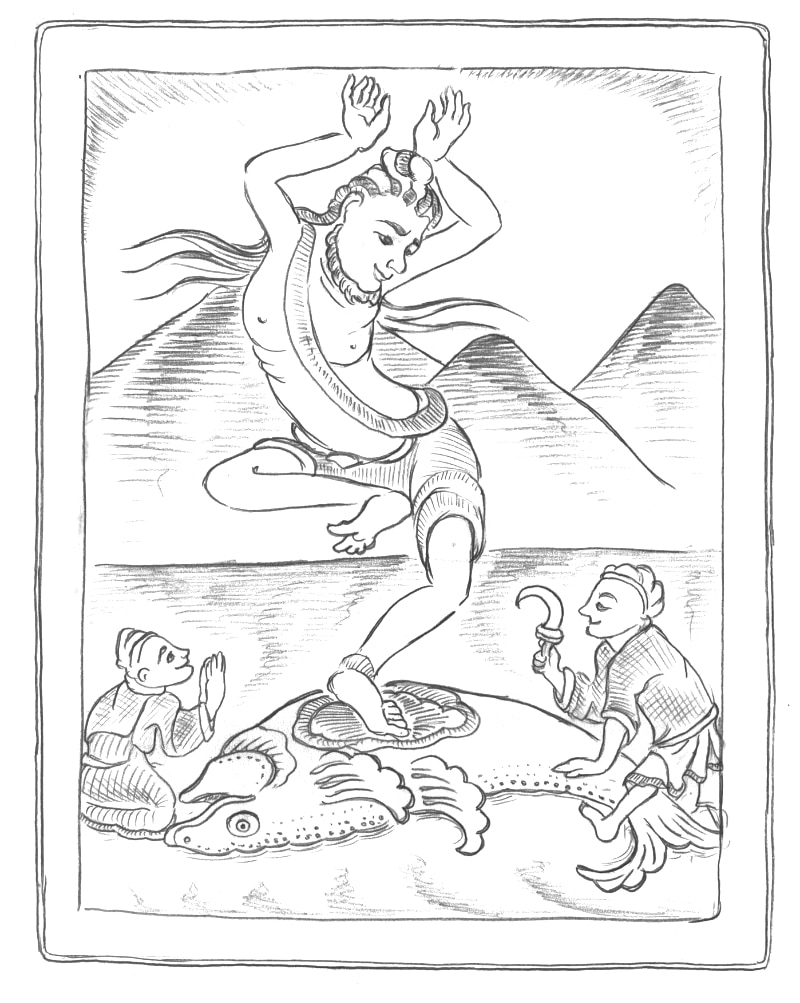
Who was Matsyendranātha really? Different perspectives
The story we recounted above is the mythical tradition as it has been preserved in the West and in later legends. But who was Matsyendranātha from the perspective of Sanskrit scholarship? The Western scholar Mark Dyczkowski, with whom Matsya is closely associated, devoted an entire lecture to this question—“Matsyendranātha and the Yuganāthas,” delivered in 2026 as part of his school, Anuttara Trika Kula. We would like to share some of his key insights here, as they paint an even richer picture.
First, the question of dating: Matsyendranātha cannot be historically pinned down to a single lifetime. Depending on the source, he is placed between the 5th and 13th centuries, in locations ranging from Bengal to Nepal and Tibet. Dyczkowski therefore describes him as a pan-Indian, transhistorical figure—less a single person than a name to which various Kaula texts and traditions attributed themselves over the centuries.
Another version: The swallowed writing
Particularly intriguing is a completely different version of the myth, as recorded in the *Kaulajñānanirṇaya*—one of the oldest Kaula texts, which, according to Dyczkowski, some have attributed to Matsyendranātha himself. Here, it is not the fisherman who is swallowed, but the secret scripture of the goddess herself:
The goddess’s son, Kārttikeya, takes the form of a mouse, steals the sacred Kula text, and throws it into the sea, where it is swallowed by a giant fish. To retrieve it, the god weaves a “net of energy” (śaktijāla), catches the fish—and, as the translation states, takes on “the form of a fisherman” to do so. Only when he opens the fish’s belly does he recover the scripture. That is why Matsyendra also bears the epithet Matsyaghna, “the slayer of the fish”—a fascinating reversal of the better-known narrative, in which he himself is the fish or its inhabitant.
Scholars disagree on which version is the more original. Some sources emphasize that Matsyendra was actually a Brahmana who, who voluntarily "descended" fisherman “descended” in order to attain the secret knowledge to reach. Others—and Dyczkowski tends toward this interpretation to – suspect the opposite: that Matsyendra was originally in fact a simple fisherman of a lower caste, to whom the later legends retrospectively a Brahmin origin were attributed in order to enhance his authority.
Abhinava Gupta's tribute
Just how deeply Matsyendra was revered in the classical Tantric world is strikingly evident at the beginning of Abhinava Gupta’s *Tantrāloka*. There, Abhinava refers to Matsyendra by his other name, Macchanda—literally “the fisherman”—and invokes his favor even before mentioning all the other teachers of his many lineages. The later commentator Jayaratha explains that Abhinava thereby unmistakably expresses his preference for the Kaula path.
According to this tradition, Matsyendra was one of four Yuganāthas—“Lords of the Ages”: Khagendranātha for the Kṛta Yuga, Kūrmanātha for the Tretā Yuga, Meṣanātha for the Dvāpara Yuga, and Matsyendranātha (Macchanda) for our present, dark Kali Yuga. As the Lord of this very last and most difficult age, he holds special significance—he is the teacher whose wisdom is said to remain accessible to us even today.
The Bengali legend: Gorakṣa saves his teacher
A third, much less well-known account from Bengal presents Matsyendra and Gorakṣa in a different light—and at the same time confirms that Matsyendra’s character as a “fallen hero,” as mentioned at the beginning, is deeply rooted in the tradition itself.
In this version, Mīna (Matsyendra), in the form of a fish, secretly eavesdrops as Śiva reveals the secret teaching to his consort—whereupon Śiva punishes him by inflicting forgetfulness upon him. At the goddess’s behest, Mīnanātha later finds himself in the “Land of Women” called Kadalī, where, surrounded by 1,600 women, he succumbs to pleasure, completely forgetting his former destiny. It is his own disciple, Gorakṣa, who ultimately rescues him—disguised as a dancer, he enters the palace and, buzzing in the form of a bee, reminds Mīna of his former life.
More about Matsyendra
If you'd like to delve even deeper into the figure of Matsyendra, you'll find further insights in our in-depth article Fish in Yoga: Matsyendra.
Source of the scholarly classification in this section: Mark Dyczkowski, Anuttara Trika Kula, lecture “Matsyendranātha and the Yuganāthas,” 2026.
This post is part of our series on the history of yoga. You can find out there how these roots live on today in our own yoga teacher training program.
More
If you want to know more about us, take a look in the downloads section!
Dort haben wir Kundalini Yoga Kriyas, Mantras und viele schöne Dinge. Nur für dich 😉
Where we go deeper in the training
History and philosophy of yoga are a module of their own in our RYT® 200h Yoga Teacher Training in the Wachau, Austria. As a standalone course they are the YACEP® History and Philosophy of Yoga, taken further in the RYT® 300h Training.
Blog