
Matsya Yoga · Knowledge
Kriyās and Classes in Kundalini Yoga
Kriyas for Your Daily Practice

The magic of yoga
These classes are a gift to enrich your practice and to let you immerse yourself in the magic of yoga.
Yoga is magic – whether we want it to be, believe in it or not.
It opens the gates to the space from which everything comes, which enriches us and in which we step into the mystery of life.
Kriya Yoga
The power of action
Each of these yoga classes is Kriya Yoga. Kriya Yoga means that yoga awakens the power of action in you.
In this way, each class lets something in you become real and builds a bridge between the subtle possible and what is actually experienced. What is wished for and longed for becomes action and experience. That is the purpose of Kriya Yoga.
Kriya Shakti is the hand of God, his feet and his arms, his embodiment. It is the power with which we carry the universal will into the world. Kriya Yoga is therefore the yoga that makes you and your actions divine.
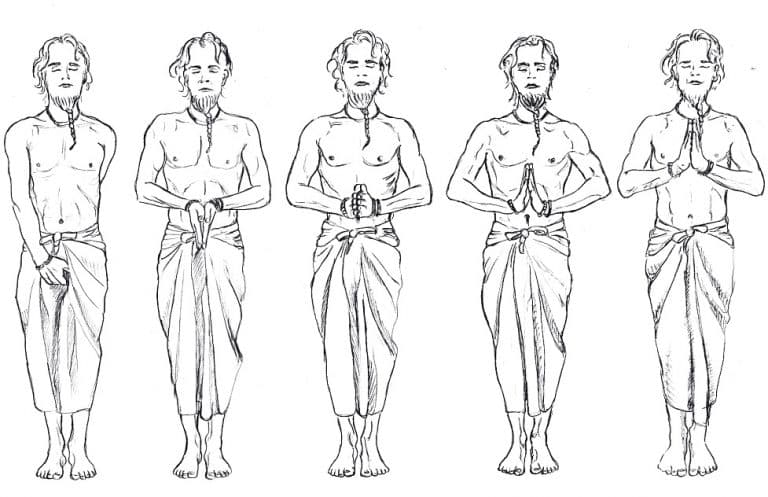
Six classes
The Classes
Each of these classes is described in full – with all postures, all drawings, the breathing instructions and the background.
They build on one another, but can also be practised on their own. If you are new, it is best to begin with the joint series. If you are looking for a complete class, take the Sādhana of the Divine Mother. And if you want to begin or end the day, the sun and moon salutations are the matching pair.

Class 1
Pavanmuktāsana 1 – the Joint Series
Why does almost every Kundalini class begin with the toes?
What do 21 small movements release that at first glance hardly look like yoga?
How do you open the joints without straining them – and why is this the foundation for everything that follows?

Class 2
Pavanmuktāsana 2 – the Abdominal Series
What does the belly have to do with willpower and self-confidence?
How do you strengthen the navel centre without forcing it?
And who was Dhīrendra Brahmacārī, whose sūkṣma vyāyāma reaches all the way into Western Kundalini Yoga?

Class 3
Pavanmuktāsana 3 – the Śakti Bandha Series
Tug of war, turning the millstone, rowing, chopping wood – why does yoga look like work here?
What are energy blockages really, and how do you actually release them?
How does apāna, the descending force, bring everything back into flow?

Class 4
Sūryanamaskāra – the Sun Salutation
Twelve postures, twelve names of the sun – what lies behind them?
How does a warm-up exercise become a tool of Kundalini practice?
With mūla bandha, with kapālabhāti or with mantra: four forms, one sequence.

Class 5
Candranamaskāra – the Moon Salutation
The cooling counterpart to the sun – for the evening and for the full moon.
What happens when we turn towards the mind, the ego and our dreams instead of fighting them?
The eight Mātṛkās, the phases of the moon and the practice with bhrāmarī.

Class 6
The Sādhana of the Divine Mother
A complete class from the Satyānanda lineage, passed on by Svāmī Vidyanand.
Twelve postures, and in each of them: deep breathing, kapālabhāti, bhrāmarī and the mantra Oṃ Mā.
At the end comes the bīja nyāsa – placing the seed sounds into the body.
All Classes as PDF
Each of these classes is also available as a PDF to print out and take to your mat – with all drawings, breathing instructions and mantras.
In the download area you will also find the sound examples for the bīja nyāsa, further kriyās, mantras and handouts from the training manual. All freely accessible.
Would you like to use the PDFs, the drawings or the texts? Simply link to our website – then it is all yours, and you support our project as well.
Further reading
Deepen Your Practice
The background
The map behind every kriyā is the chakras – where they come from, what they mean and how to work with them.
How the two paths relate to each other is explained in Hatha and Kundalini Yoga. Yoga & Philosophy sets out the wider framework, and the History of Yoga shows where it all comes from.
The Pavanmuktāsana series come from the lineage of Svāmī Satyānanda Sarasvatī and the Bihar School of Yoga.
Practise with us
You can find the current dates under weekly yoga classes. Longer formats are offered at our retreats in the Wachau.
If you would like to teach these classes yourself, they are an integral part of our RYT 200h Yoga Teacher Training. For teachers who are already certified, there is the RYT 300h Training and the YACEP Chakra Workshop.
Both are also available in an online and hybrid format.
Practice
How Do You Practise the Exercises Correctly?
The exercise itself is the teacher. It is guru. Guru is in the breath, guru is in the posture, guru is in the focus.
Your doubt, your fear, your moods or whatever else moves you cannot add anything to the exercise itself or to the teacher who dwells within it.
Through our attitude, however, we can give the spirit that dwells in the exercise room to live through us. This spirit is the fully awakened power of action, and it has three components:
The Yoga Sutras of Patañjali say:
The yoga of action (Kriya Yoga) consists of three components:
Tapas – discipline (heat or intensity)
Svadhyaya – refinement (self-study)
Ishvara Pranidhana – surrender to God
Pātañjalayogasūtra II.1–2
These are therefore also the three things that should be your contribution to the practice:
When you practise, practise with discipline and playful lightness, observe attentively everything you do, and surrender to the universal – trust in God, in the Goddess, in the heart at the centre of all things.

The book
The Book for the Classes
In this book you will find all the yoga classes presented here – complete, with all the illustrations and the background.
I illustrated every class myself, by hand, in pencil on paper. These classes are something personal. A book for you!
A reading sample is available in the download area; you will find all our books under Books and on the page Kriyās and Classes in Kundalini Yoga.