What makes the pre-classical era so decisive?
Because it is here that the tension first arises which shapes yoga to this day: the opposition between radical withdrawal from the world and loving turning towards it. On one side the Śramaṇas, who drove the body to its limit and beyond. On the other the Bhagavad Gītā, which finds the divine in the midst of action.
Both currents still echo today – and both reappear, transformed, in what we practise now. Previously we looked at the oldest roots of the word yoga.
Around 500 BCE a radical ascetic movement developed in the region of present-day Allahabad – and shortly afterwards a single poetic text would change the direction of yoga forever.

Who were the Śramaṇas?
These ascetics, known as Śramaṇas (meaning "strivers/seekers"), emerged around 500 BCE. Although they developed independently of the Brahmanical traditions, they were most likely influenced by Vedic thought.
Their principal concern was to develop meditation techniques (dhyānas) in order to escape the cycle of death and rebirth and to attain enlightenment (nirvāṇa) or liberation (mokṣa).
Their techniques were designed to achieve a complete "destruction of individual being". Although these techniques were not themselves called yoga, their goal of liberation through total self-sacrifice planted the seed for later yogic techniques.
Despite their rejection of Vedic authority, their ideas found their way back into the Vedas. Indeed, the Mahābhārata of the 3rd century BCE speaks of dhyāna yoga (the yoga of meditation), which had developed out of the Śramaṇa tradition.
Notable (and harrowing) practices of the Śramaṇas include:
- Standing throughout one's entire life and never sitting down.
- Directing the gaze towards the sky and never looking down.
- Placing the hands on the chest and never opening them again.
- Hanging the body upside down from a tree above a fire.
- Raising both arms to the sky and never lowering them again.
- Remaining forever in a seated posture, never lying down or standing up.
This is a small selection of the 18 ascetic devotions to Brahma. Many of them are rather terrifying and, if practised successfully, even lead to death. Nevertheless, the willpower underlying them forms the foundation for "tapas", yogic discipline or asceticism. Even today one can still find sadhus practising these techniques in their original form.
What remains today of the Śramaṇas' asceticism?
Not the extreme practices – but their core. What has survived from the Śramaṇas is the term tapas, literally "heat": that inner glow which arises when one endures something against one's own resistance.
In this tempered form, tapas has remained a load-bearing concept. Patañjali later places it at the beginning of his second chapter, and it is a recurring theme in our own yoga teacher training as well. The question is never how much one can endure – but what awakens in a person through the enduring.
Why does the Gītā matter so much for yoga?
Yes, the Bhagavad Gītā is of fundamental importance for yoga – for a reason easily overlooked: it is the first text to describe yoga not as a withdrawal from life, but as a way of standing in the midst of it.
Its setting is a battlefield; its conversation takes place between a doubting warrior and his charioteer. In doing so it takes up precisely the image already contained in the word root of yoga – the chariot, the reins, the horses. What was still metaphor in the Vedas becomes a question here: how does one act rightly when one no longer knows what is right?
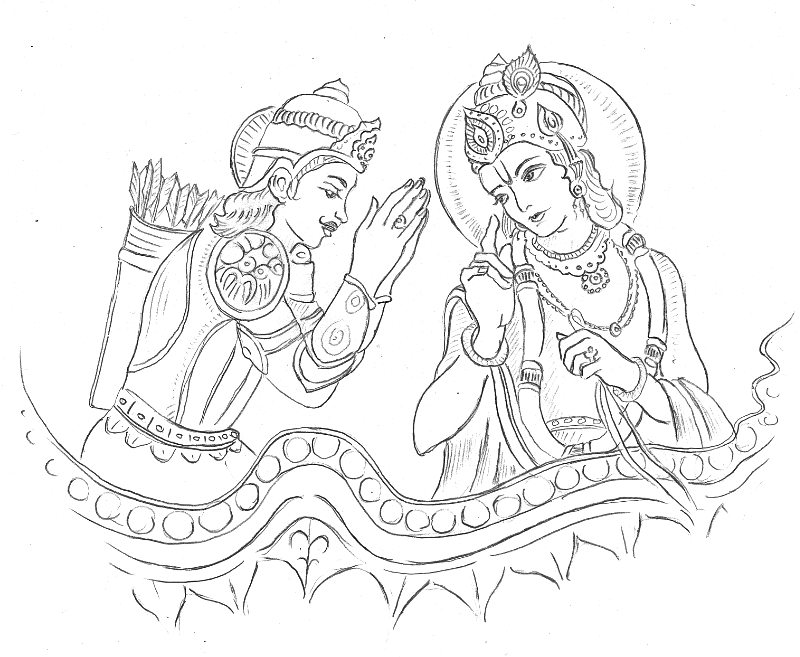
Which four paths of yoga does the Bhagavad Gītā describe?
About 100 years after the emergence of the Śramaṇas, the Bhagavad Gītā explored the paths of union with the divine. The Bhagavad Gītā is a profound journey into the nature of the soul and a poetic exploration of the meaning of existence. It described the four principal paths of yoga:
- Karma Yoga – the yoga of action.
- Bhakti Yoga – the yoga of devotion.
- Jñāna Yoga – the yoga of knowledge.
- Rāja Yoga – the royal path (meditation and prāṇāyāma).
Today, because it is a classically dualistic text, its significance for the spirit of yoga is often overlooked. The Gītā is not only breathtakingly beautiful and dramatic; above all it lays the ethical foundation for the path of yoga and for the path of Patañjali Yoga. It also possesses a particular quality of heart, rare among the other scriptures of yoga. It is warm and aflame.
I am the ritual and the worship, the medicine and the mantra, the butter burnt in the fire, and at once also the flames that consume it.
I am beginning and end, origin and dissolution, refuge, home, true lover, womb and imperishable seed.
Bhagavad Gītā (9:16,18)
What did Buddhism contribute to yoga?
Two centuries before Patañjali's Yoga Sūtras, Buddhist schools began practising meditation techniques which they called 'yoga'. These schools were known as Yogācāra. Their body of knowledge and texts is said to have been more extensive than that of Patañjali Yoga. Yogācāra reached its fullest maturity in Buddhist Tantra and forms the foundation of today's Buddhist-tantric yoga.
In the next article we enter the classical era – with Patañjali's Yoga Sūtras and the Upanishads.
More
If you would like to know more about us, take a look at our Downloads area!
There you will find Kundalini Yoga kriyas, mantras and many beautiful things. Just for you 😉
Where we go deeper in the training
History and philosophy of yoga are a module of their own in our RYT® 200h Yoga Teacher Training in the Wachau, Austria. As a standalone course they are the YACEP® History and Philosophy of Yoga, taken further in the RYT® 300h Training.
Blog