
What makes the classical era a turning point?
Because here, for the first time, yoga ceases to be a loose collection of practices and becomes a system. What had lain scattered for centuries across hymns, asceticism and poetry now receives an order, a structure and a declared goal.
Previously we looked at the pre-classical era with the Śramaṇas and the Bhagavad Gītā.
Building on Sāṃkhya and Buddhist influences, yoga as we know it today began to develop as an independent philosophy. The Sāṃkhya, whose philosophy shared many similarities with yoga, differed primarily in that – like the Buddhists – they were atheistic and rejected the existence of a para-puruṣa, īśvara, that is, God.
Yoga, by contrast, took a distinct path as a theistic philosophy and accepted devotion to a personal God as one way towards samādhi.

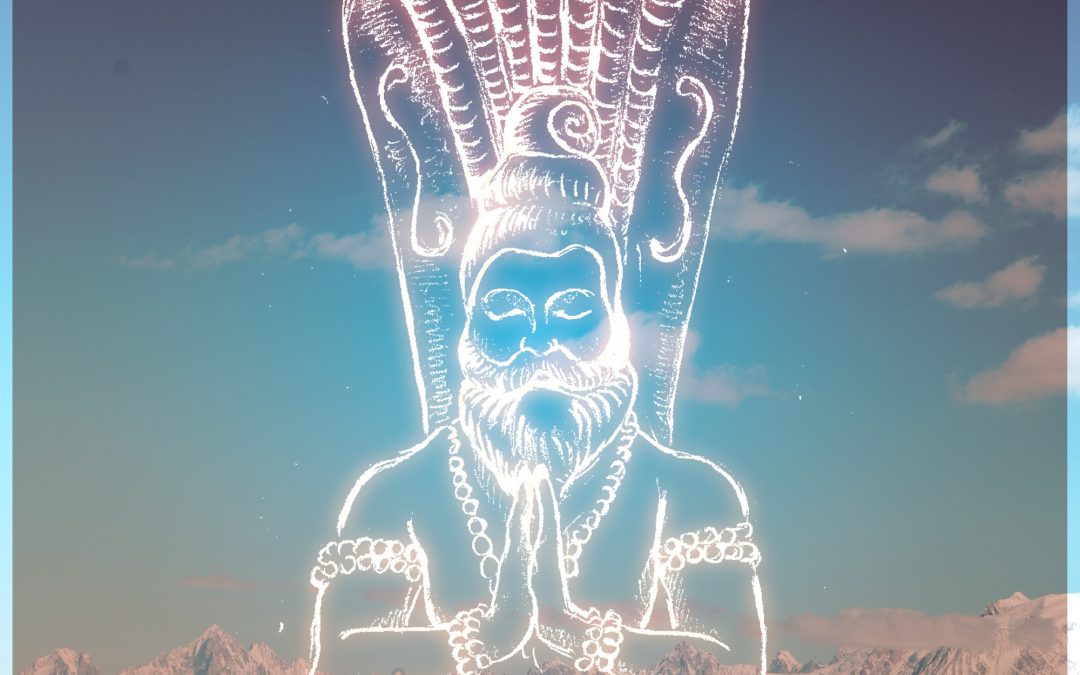
What is written in Patañjali's Yoga Sūtras?
Patañjali created what is probably the most significant work for yoga as we know it today – the Yoga Sūtras. These sūtras (meaning "thread") are a guide along the path of Rāja Yoga, mentioned earlier in the Bhagavad Gītā. Broadly, the sūtras describe what yoga is, its path and its practice, and beyond that the mystery of reality.
At the beginning of the second chapter – the most important one for us – Patañjali refers to the yogic discipline of tapas (literally "heat") as the force capable of awakening Kriyāśakti, the power of action. This Kriyāśakti is the precondition for overcoming the causes of suffering (kleśas) and reaching samādhi. Tapas refers back to that spirit of complete sacrifice practised by the Śramaṇas. In a sense, Patañjali Yoga is a refined further development of the ascetic Śramaṇa traditions.
In the chapter Sādhana-Pāda (chapter 2 of the Yoga Sūtras), Patañjali explains eight consecutive stages of self-knowledge as the eight limbs of yoga. Within this system, self-knowledge is attained through the gradual development of discernment (viveka), which can distinguish between the world and its unchanging eternal perceiver.
Because Patañjali's yoga emphasises the eight (aṣṭāṅga) limbs as stages of insight, it is often regarded as Ashtanga Yoga. The Tantras, which arose some 500–800 years later, absorbed these teachings into their corpus and developed them further into what we know today as Hatha Yoga (the yoga of force).
What are the eight limbs of yoga?
The eight limbs (aṣṭāṅga) are Patañjali's answer to the question of how a person arrives, step by step, at self-knowledge: yama (how we meet others), niyama (how we meet ourselves), āsana (seat/posture), prāṇāyāma (breath), pratyāhāra (withdrawal of the senses), dhāraṇā (concentration), dhyāna (meditation) and samādhi (absorption).
What stands out is how little space physical posture occupies: āsana is only one of eight limbs, and Patañjali describes it with remarkable brevity. What is commonly called "yoga" in the West today is, in a sense, one eighth of what he meant. How these eight limbs work together in a contemporary practice is a central theme of our yoga teacher training.
Ignorance can be removed by cultivating an uninterrupted discernment between consciousness and the world.
Pātañjala-Yoga-Śāstra (2:26)
What are the Upanishads?
The Upanishads are an essential part of the Vedic tradition and are often described as its conclusion – the Vedānta, as the philosophy of the Upanishads is called. There are 108 significant Upanishads forming the canon Muktikā, the collection of freedom. The term Upaniṣad derives from the word upadeśa, meaning "teacher", indicating that the teachings within them are living and active.
The very first Upanishad to name yoga as we use the word today was the Kaṭhopaniṣad, written around 300 BCE. Like the earlier Vedas it uses the image of the chariot to represent the person striving for liberation. In this image, the person standing in the chariot is the ātman, the soul. The buddhi, or intellect, is the charioteer, and the mind (mānas) is represented by the reins. This mind controls the senses (indriya), which are the horses, and the object of the senses is the very road they travel.
The Kaṭhopaniṣad explains that it is yoga itself which tames this mind, so that the reins are held in the interest of the soul and the right path can be found.
Why does the image of the chariot keep returning?
Because it may be the clearest description of what yoga actually does. We already met it in the very first article of this series, where the word yuj denoted the yoking of chariot and horses – and here, centuries later, the same image reappears, now as a complete teaching.
This recurrence is no accident. The image holds fast to the fact that yoga suppresses nothing, but guides. The horses are not killed, the senses not abolished. They are given a direction. This is precisely where the yogic path differs from the pure asceticism of the Śramaṇas.
Through this uninterrupted practice the Parichaya state is attained. Vāyu, through tireless practice together with the power of fire, awakens the Kuṇḍalinī and then enters the Suṣumnā without interruption. When the Citta flows together with Prāṇa into the Suṣumnā, consciousness reaches the high throne through the power of Prāṇa.
Yoga-Tattva Upanishad (81–83)
In the next article the classical era continues – with the Tantras (Āgamas) and the worship of the divine.
More
If you would like to know more about us, take a look at our Downloads area!
There you will find Kundalini Yoga kriyas, mantras and many beautiful things. Just for you 😉
Where we go deeper in the training
History and philosophy of yoga are a module of their own in our RYT® 200h Yoga Teacher Training in the Wachau, Austria. As a standalone course they are the YACEP® History and Philosophy of Yoga, taken further in the RYT® 300h Training.
Blog


