

What is real about the chakras?
Map of Experience
There are many skeptics when it comes to the chakras. And for good reason—after all, why should anyone believe in colorful wheels inside the body? As far as I know, no one has ever found such a wheel during a dissection class.
However, this approach is based on a major misunderstanding: The chakras are not physical organs, nor can they be clearly associated with any specific gland; rather, they are a map of our inner experience. This experience is human and real—real as an experience, not real as an object.
At the same time, the radiant power of the chakra is one that we awaken when we have the courage to enter our inner landscapes. It is therefore not a fixed reality that exists outside the steps you take yourself.
The power of meditation—bhāvana—brings her from the threshold of nonexistence into life.
Nevertheless, its reality as a map of experience is undisputed. The yogis, who had often spent their entire lives in deep contemplation, recognized that the experiences of the individual self do not arise without some inner form. Feelings and even thoughts have a structure within the body, much like a geometry of experience.
The central axis of this inner map is suṣumnā, the nāḍi that runs from the base of the body to just above the head. It is the playground of this inner experience. If you observe yourself in daily life, you can see that all inner experiences arise along the vertical axis of suṣumnā and dissolve there again.
So our love isn't located in our elbow, but in our heart. Your sexual arousal isn’t in your ear, but in the center of your pelvis. Your fear is in your stomach, just like your strength. When you have a great idea or a flash of inspiration, it appears as a bright thought or image above your head—not deep down in the earth.
This vertical orientation of your inner psychological experience—which is common to all of us as human beings—is the reason why the chakras are aligned along this axis.
The ancient tantrikas knew this and therefore placed the deities in these specific areas of self-experience. The underlying logic was that when a force is placed at the center of the landscape of our self, the self must then become part of that force.
Where else should the divine be worshipped but in the temple of one's own self?

The Trinity of Power
The Three Forces
The first system of chakras, in which they are described as significant centers of the body’s life force, originates from Taoism and is still taught today in the form of the lower, middle, and upper dantien (tan t’ien—sea of qi).
This Dantien is also known in exactly the same form in traditional Tantra. In Tantra, the lower Dantien is called kanda and is described as being in the same position and having the same attributes as in Taoism. It is located three finger-widths below the navel, is egg-shaped, and has a radiant golden color.
The two higher centers of the middle and upper dantien correspond to what are known in yoga as anāhata and ājñā.
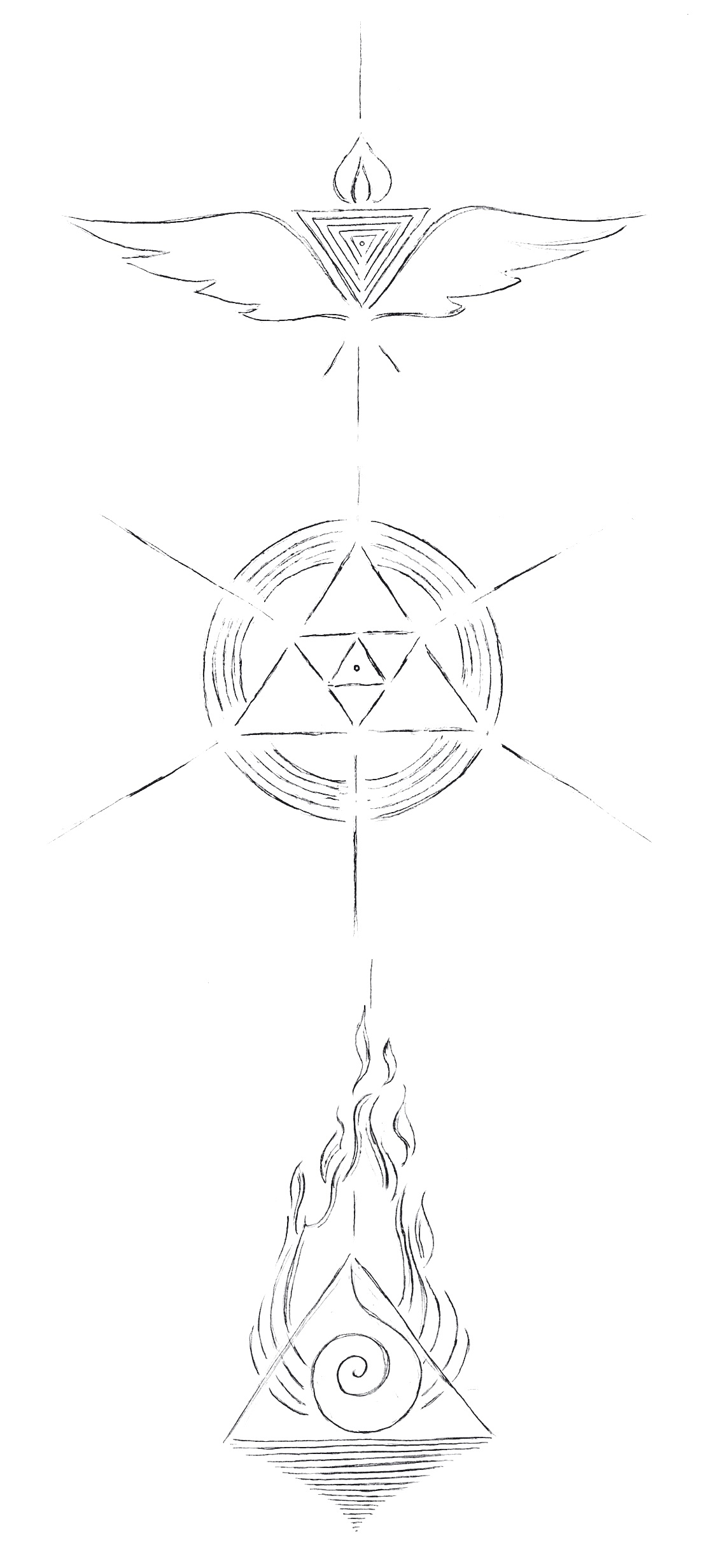
This division of energy into the lower, middle, and upper centers is the most fundamental reality of the chakras and the structure of the self.
We move back and forth between the Earth’s magnetic force and the sky’s electrical force; our center is the heart, the seat of our very life.
The Tantrikas used a meditation technique in which Kuṇḍalinī was awakened in the body’s three major centers: in the kanda as the fiery Ādhāra Kuṇḍalinī, in the heart as the light of truth—madhya Kuṇḍalinī—and in the head as the divine will—Ūrdhva Kuṇḍalinī.
Kuṇḍalinī is then channeled from the trinity of these centers into the center, where it merges with the soul—the center of being.
THE GREAT IMPORTANCE OF THE CHAKRAS
Nowadays, the chakras are typically viewed as the centers of our emotional well-being as well as the seats of supernatural powers. Crystals, colors, singing bowls, and massages are said to help awaken the hidden powers within these centers and guide us back to harmony.
Along with all of that, however, the most important treasure that the chakras hold for us has been forgotten.
The greatest gift of the chakras is that they are gateways located within our bodies through which we can enter into our experience. The chakras chart a map of experience, and like any map, this one serves as a guide. We can now find the places we’re looking for, instead of wandering aimlessly through the fog of our experience.
Through these gates, the yogi can gain access to a certain power, to a certain experience of the self.
For example, the Śiva Saṃhitā (3:73) mentions that meditation (e.g., dhāraṇā for two hours) on a chakra enables the practitioner to overcome the limitation present there and awaken a power. For instance, the limitation of fire is overcome through meditation on maṇipūra, and the limitation of the element of air is overcome through meditation on anāhata.
Successive meditation (dhāraṇā) on all the centers makes it possible to drink the “nectar of immortality.” These ancient techniques are only a fraction of the ways to awaken powers through their gateways in the body and to unfold the potential of the human psyche.
The body is a mirror of the universe, so all deities—as well as worldly experiences—must find a home within it. The body is a vast landscape, full of temples, oceans, mountains, and beings of all kinds.
The experiences of the self are the seasons of these landscapes and the seismic activity of their earth, the swirling of their winds, and the radiance of their stars. In the temples of these landscapes, the earthly meets the divine, and when you enter the temple within, you are truly at home.
Within this human body, Mount Meru (the spine) is surrounded by seven islands; there are rivers, seas, mountains, fields, and lords of the fields. Within it are seers and sages; all the stars and planets are there as well. There are sacred pilgrimages, shrines, and the presiding deities of the shrines. The sun and moon—the forces of creation and destruction—also move within it. Ether, air, water, and earth are there, too.
Śiva Saṃhitā (3:1–3)
A MODERN UNDERSTANDING of the Chakras
When the Ṣaṭ-Cakra-Nirūpaṇa was first translated into English in 1912, the concept of psychic centers in the body resonated deeply with readers and practitioners of that era.
The Theosophical Society, led by the occultist Madame Blavatsky in Chennai, was deeply inspired by the concept of the chakras and linked it to human anatomy. In their view, the chakras had to have anatomical counterparts, and since the glandular system had recently been rediscovered at that time, they attempted to explain the functions of the chakras through those of the glands and, in this way, to establish correspondences between the two systems.
Later, the magician and occultist Aleister Crowley also wrote about Kundalini Yoga; he quickly became a hero of the New Age movement. However, the most important bridge to the West was built by the prominent Swiss psychologist Carl Jung.
He spent three months traveling through India, where, after visiting a Kali temple, he had a vision of the goddess. He was so fascinated by India’s spiritual power that he began giving lectures on Kundalini Yoga in 1932. These groundbreaking lectures led to his famous book, *The Psychology of Kundalini Yoga*.
Jung proposed many ideas that later merged with the New Age movement and shaped our understanding of the chakras as an expression of an individual’s psychological evolution. For Jung, spiritual evolution—symbolically represented by the sequence of chakras—was a macrocosmic expression of the individual’s psychological evolution.
This understanding of the chakras—which was developed in the *Ṣaṭ-Cakra-Nirūpaṇa* and later reinterpreted by Jung in light of modern psychology—is now regarded as the most important chakra system not only in the West but also in India itself.
In any case, the chakra system is undoubtedly multidimensional, and many interpretations may point to a deeper truth. In this respect, this Jungian psychological interpretation of the chakras is just as much a revelation as the realization that the spiritual evolution of the cosmos is reflected in the individual.
Both visions can deepen our understanding of ourselves and the cosmos.
Learn more about the chakras here
A journey through the chakras is a journey to yourself.
In this book, we also explore the roots of Kundalini Yoga and yogic anatomy, and we discover the secrets of the koshas, prana, and the Trinity of the Goddess.
These profound practices, visions and insights into yogic anatomy and chakras will inspire and enrich any yoga practice.

More Articles Weekly
We'll be posting new articles every week on the individual chakras, the koshas, and topics in yogic philosophy. Stop by or send us an email so I can add you to our newsletter mailing list.
Any questions? Just write to us!
Where we go deeper in the training
The chakras are a core subject of our RYT® 200h Yoga Teacher Training in the Wachau, Austria. If you already teach, go further in the RYT® 300h Training – or join the YACEP® Chakra Workshop.