NĀḌĪS & PRĀṆAS
When the nāḍīs are impure, the breath cannot enter the suṣumnā. Then the yogi achieves nothing, nor can he reach a state of deep concentration.
— Haṭha-Yoga-Pradīpikā (2:4)
The map of the breath
Every breathing technique in yoga – whether alternate nostril breathing, Ujjāyī or Kapālabhāti – works with something that cannot be seen: the nāḍīs (often simply written nadis), the channels of life energy, and the prāṇas, the currents that flow within them. Whoever knows what the nadis are and how the prāṇas flow in them understands why the breath moves not only air, but consciousness.
The following sections are taken from our book on the roots of Kundalini Yoga. They form the foundation for all techniques in our series Prāṇāyāma – the breath of life.
What are the nāḍīs (nadis)?
A nāḍi is a channel for prāṇa (life force), an energy channel. The Śiva Saṃhitā mentions that there are about 350,000 energy channels in the body (other scriptures speak of about 72,000). Even if the descriptions disagree on the number of channels, they share the view that the channels through which the life force flows in our body are so numerous that our mind cannot grasp them.
The nāḍis are the channels that carry prāṇa, the carrier of experience. All expressions and, conversely, all experiences of being flow through the nāḍis. This is where our feeling of the world takes place, and how, in sensation, we respond to the impressions of the world. When the nāḍis are blocked or polluted by experiences, new states of energy cannot take form in them. In this way we become estranged from ourselves and, ultimately, from the world.

Where do the nadis originate – and what is the kanda?
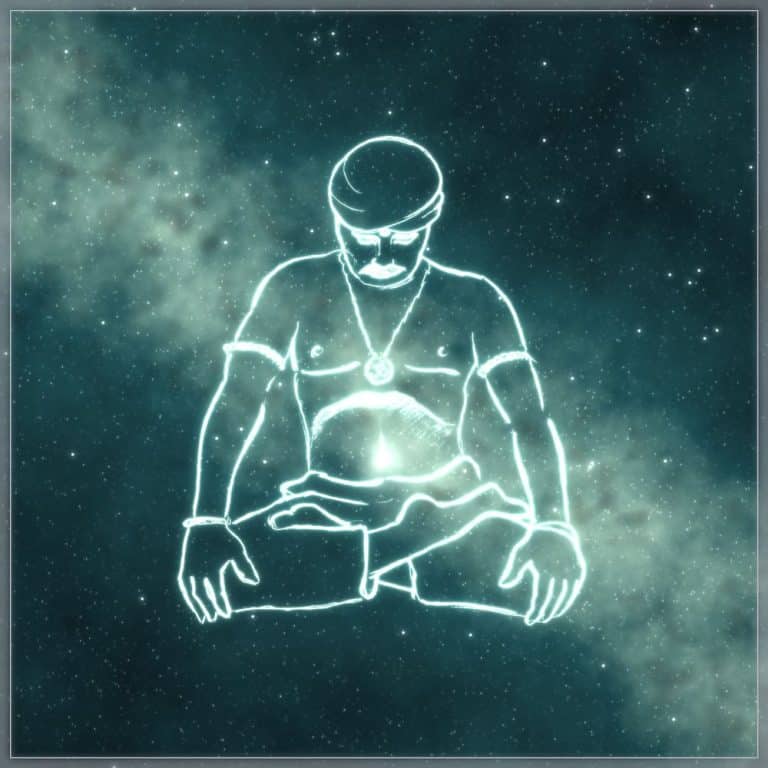
The nāḍis originate in the lower part of the body, where consciousness stands between the physical and the mind. According to the Śiva Saṃhitā, they arise from the mūlādhāra chakra, as do the three most important nāḍis – iḍā, piṅgalā and suṣumnā. There is, however, general consensus that there is a centre of the prāṇas between the navel and the genitals, from which the nāḍis distribute energy through the body – a view shared by North Asian traditions as well. This centre, which rests in prāṇāmaya kośa and is connected on the level of consciousness with svādhiṣṭhāna chakra, is called kanda. It is said to have the shape of a golden egg and to be the centre of all bodily energy.
Above the genital organ and below the navel lies kanda, in the shape of a bird’s egg. From there arise 72,000 nāḍis (…). This chakra of the nāḍis should always be known by the yogis. The three nāḍis iḍā, piṅgalā and suṣumnā always carry prāṇa and have as their devatās the moon, the sun and fire.
— Dhyānabindu Upaniṣad (50–55)
Incidentally, Kapālabhāti is practised from this very golden egg – the breath of fire begins exactly here, at the navel point.
What are iḍā, piṅgalā and suṣumnā?
The Śiva Saṃhitā (2:13) teaches us that while fourteen of these nāḍis are important, only three are decisive for yoga. And of these three, only one is of particular significance. These three nāḍis are iḍā (nourishing, libation), piṅgalā (reddish) and suṣumnā (graceful) – in simplified spelling ida, pingala and sushumna.
Iḍā is the river of the moon, which carries the unconscious states of sleep, dream, vision and introversion. Piṅgalā is the river of the sun, which carries wakefulness, conscious thought, action and extroversion. Iḍā is also citta (mind), the field in which everything mental manifests. Piṅgalā is also prāṇa, which sets all life in motion.
| Meaning | Light | Place | Prāṇa | Aspect | |
|---|---|---|---|---|---|
| Suṣumnā | Graceful | Fire | Centre | Udāna | Knower |
| Piṅgalā | Reddish | Sun | Right | Prāṇa | Knowing |
| Iḍā | Refreshing | Moon | Left | Apāna | Known |
These two states of being are seen as two rivers, between which a third exists – a state that is neither conscious nor unconscious. This is the state of meditative insight. It is suṣumnā, which consists of three layers that reflect the threefold nature of the universe. Its innermost layer, sattva, is called citrini nāḍi and is regarded as the gateway to heaven and to the world beyond.
Furthermore, suṣumnā is the nāḍi that reflects the detached nature of consciousness, resting in the centre. It is the state of meditative absorption. This state is the basis for the realisation of truth, which can only truly be known beyond the subjective states of consciousness of extroversion and introversion.
Sushumna – the stairway to heaven
In the Upanishads, the nāḍis are compared to channels filled with oil. The oil absorbs the flavour of every action experienced or performed by the individual. The suṣumnā, however, carries the oil that cannot take on any flavour or scent, the oil that – like the true Self – is unchangeable and eternally pure. Suṣumnā is therefore the carrier of the energy of the Self, of the knower. This seems to be the reason why the Chāndogya Upaniṣad describes suṣumnā as the stairway to heaven along which the soul can ascend at death to attain eternal existence and freedom.
But when he dies and separates from his body, then he goes upward along those rays; [if he is a knower] he surely goes upward meditating on Oṃ, or [if he is not a knower, he does not go upward]. However long it takes for the mind to travel, in that short time he goes to the sun. That indeed is the door to the world of Brahman, an entrance for the knowing and a barrier for the unknowing.
There is this verse about it: A hundred and one are the nāḍis of the heart; one of them leads up to the crown of the head. Going upward through this suṣumnā, one attains immortality, while the other nāḍis serve only to point in other directions.
— Chāndogya Upaniṣad (8:6:5–6)

What are the five prāṇas (vāyus)?
The prāṇas are the phenomena that arise on the level of prāṇāmaya-kośa (the level of consciousness of prāṇa). Prāṇa is that which dwells in the body as the breath of life and creates the organising intelligence in living beings. The Taittirīya Upaniṣad says that prāṇa is the soul of the physical body; it gives life to matter and in this way distinguishes between the life and death of things.
Prāṇa acts as the carrier of experience within consciousness and is, above all, the first form that emerged from the formless. It gives substance to life. In this context, ‘OṂ’ is called praṇava, the sound that projects prāṇa into the void. It is the first form of being.
| Name | Movement | Seat | Governs |
|---|---|---|---|
| Prāṇa | Inward | Heart | Liver, lungs, heart, circulatory system |
| Apāna | Outward | Pelvis | Reproduction, large intestine, genitals, organs of excretion |
| Samāna | Central, circular | Stomach | Energy, digestion, immunity, skin, agility |
| Udāna | Upward | Head, limbs | Consciousness, head, arms, hands, feet, brain, endocrine system |
| Vyāna | Pervasive | Everywhere | Circulatory, lymphatic and immune system |
And how could it be otherwise: between the unconscious, that which stands at the threshold of non-being, and that which stands in the light of the knowledge of being, there can only be sensation and its quality. Sensation, without any mind, without interpretation, without reflection, without desire, without opinion, is what rises from the dream of nothingness; it is the first step into being.
Prāṇa is the quality of life, its taste, its essence. It governs the body and stores the experience of our being in particular parts of the body. Depending on the part of the body in which prāṇa moves, it changes its quality there, its taste of being. Although, strictly speaking, every part of our physical body is governed by its own quality of prāṇa, yoga distinguishes five prāṇas that are considered the most important.
Modern description
The body is governed by a multitude of vāyus (winds). Ten of these vāyus are significant, and of these, in turn, only five are important in yoga. They are: prāṇa, apāna, samāna, udāna and vyāna. The right balance of the prāṇas ensures vitality, while an imbalance leads to health problems.
Prāṇa, apāna, samāna, udāna, vyāna, nāga, kūrma, kṛkara, devadatta and dhanañjaya – these are the ten principal names described in this scripture; they carry out all bodily functions, driven by their own powers. Again, of these ten, the first five are the most important; and even among these, prāṇa and apāna are the highest powers, in my opinion. The seat of prāṇa is the heart; of apāna the anus; of samāna the region above the navel; of udāna the throat; while vyāna moves throughout the whole body... Whoever knows the microcosm of the body in this way is freed from all sins and attains the highest state.
— Śiva Saṃhitā (2:4–9)
Our practice series also show how the five vāyus can be addressed in practice – for example Pavanmuktāsana 3, which activates apāna.
How do the Tantras understand the prāṇas?
In the early tantric traditions, the prāṇas were understood not only as energy dwelling in and animating different parts of the body, but also as five forms of the unfolding of energy along the stages of meditation.
In this light, prāṇa and apāna (which govern inhalation and exhalation) are seen as expressions of the two primary states of consciousness, iḍā and piṅgalā. Samāna prāṇa is seen as the concentrated point of stillness that arises when the two fundamental forces of consciousness are in balance. Udāna is understood as the expression of Kuṇḍalinī, which rises as soon as the power of samāna can draw consciousness into the stillness of the centre. Vyāna is then the state of all-pervading consciousness; there Kuṇḍalinī can unfold in the vastness of space – it is her true abode.
This perspective is very valuable for the practice of prāṇāyāma, as it explains the process of the unfolding of the breath and how it leads to a spiritual experience. The practising yogi can then concentrate on the process of transformation of the prāṇas, to which their balance automatically leads.
Taking this perspective, one recognises the prāṇas as a successive chain of steps towards ecstasy: first the flow of the breath, then from balance to the power of the centre, to the rising of this fire, to the expansion in the space of being.
| Name | Movement | Consciousness |
|---|---|---|
| Prāṇa | Outward | Energy of external perception |
| Apāna | Inward | Energy of internal perception |
| Samāna | Central, singular | Energy of one-pointed silence |
| Udāna | Upward | Energy of meditative absorption in bliss |
| Vyāna | Pervasive | Energy of formless samādhi |
Our modern view of the prāṇas and the direction of their flow, especially of the two most important prāṇas (prāṇa and apāna), comes from their anatomical movements – for example, apāna would flow outward, like the excretion it governs.
In this refined view, however, the pranic movements refer to their mental, subtle functions. This explains why the tantric Abhinava Gupta taught a reversed understanding of the flow of prāṇa and apāna. Here prāṇa is the power that creates outer experience; therefore it flows into the outer object and governs exhalation, while apāna is the power that draws experience inward and so makes it possible; thus apāna flows in and governs inhalation.
Then, by virtue of the exhalation (prāṇa), consciousness flows through the sense organs and rests on an external object. Then, as the yogi fills himself with the ‘moon’, he inhales (apāna) and brings the object with him; thus he sees himself in all things and becomes free of all desire for anything else. Next, through the arising of the balancing power (samāna) in the centre, he experiences rest in unity. Then the fire of the breath rises (udāna Kuṇḍalinī); she absorbs the powers of the perceiver, the perceived and the process of perception itself. When the upward-striving fire subsides and the all-pervading (vyāna) vital energy arises, one vibrates free of all limitations.
— Tantra-Sāra (5)
You can find more about Abhinava Gupta and the tantric schools in our article on the Tantras (Āgamas).
What does this mean for your breathing practice?
The yogic anatomy reveals the logic of the breathing techniques in our series:
- Purify: As long as the nāḍīs are blocked, the breath cannot enter the suṣumnā. That is why alternate nostril breathing (Nāḍī Śodhana) comes first – it balances iḍā and piṅgalā.
- Gather: In kumbhaka, the retention of the breath, inhalation and exhalation, moon and sun, come to rest – the power of the centre, samāna, arises.
- Reverse: Mūla Bandha reverses the downward current of apāna and unites it with prāṇa.
- Kindle: Kapālabhāti and Bhastrikā awaken the fire at the kanda – udāna begins to rise.
- Expand: Sound and silence – for instance in Bhrāmarī – let consciousness expand into space (vyāna).
We describe the chakras through which the suṣumnā rises in detail in our series on the chakras in Kundalini Yoga.
The series: Prāṇāyāma – the breath of life
This article is part of our series Prāṇāyāma – the breath of life. There you will find the foundations – what prāṇāyāma means, how to sit, when and how long to practise – and an overview of all breathing techniques:
- Nāḍīs and Prāṇas – the channels of life (this article)
- Kumbhaka and alternate nostril breathing (Nāḍī Śodhana)
- Ujjāyī, Bhrāmarī and Śītalī
- Kapālabhāti and Bhastrikā – the breath of fire
- Mūla Bandha and the three bandhas
If you would like not only to practise prāṇāyāma but also to teach it: in our 200-hour yoga teacher training, the breath is one of the supporting pillars alongside āsana, mantra and meditation.

Prāṇāyāma practices to download
In our download section you will find our prāṇāyāma handout and many more practices – Kundalini Yoga kriyās, Pavanmuktāsana series and mantras.
All practices are illustrated by hand and lovingly designed. They will enrich and deepen your yoga practice. Come by and practise with us! With love!

Any questions? Just write to us!
Blog