

Note: All exercises are illustrated by hand with a pen and written by Clemens Biedrawa.
Pavanmuktāsana 3 – the Śakti Bandha Series in Kundalini Yoga
The third part carries a name that makes you sit up: Śakti Bandha Vyāyāma – the series for releasing energy blockages.
Part 1 opened the joints, part 2 strengthened the centre. Part 3 takes what has been freed and sets it flowing. The exercises are more dynamic, louder, more physical than anything before – pulling a rope, turning a millstone, rowing, chopping wood. This is the series in which yoga looks like work.
And that is exactly the point.

The Series for Releasing Energy Blockages
Swami Satyānanda, a renowned teacher, was the first to make this unique sequence available to the West. It is an integral part of sūkṣma vyāyāma, the subtle exercises of yoga.
The pavanmuktāsana series aims to optimise the flow of energy, to promote vitality and to strengthen the centre. This particular sequence also activates apāna prāṇa, the life energy that streams through the hips, the abdomen and the legs. Apāna prāṇa supports the will to live, self-confidence, digestion and sexual vitality.
The particular strength of this series lies in its capacity not only to intensify the flow of energy at the base, but also to cultivate fundamental warmth, trust and strength.
The presentation of this series follows the practice of our Kundalini Yoga tradition. Let yourself be enchanted by its beauty!
How to Practise This Series
Because these exercises are meant to work primarily on the subtle level and to interact with the energetic body rather than only with the physical one, it is essential to practise them with a focus on breath and rhythmic movement.
- Two base postures. The first part of the series takes place in daṇḍāsana, the seat with the legs extended. The second part moves into the squat – where apāna is at home.
- Titalī āsana is the pause. Between the strong exercises you return again and again to the butterfly, often with bhrāmarī, the humming of the bees.
- Mūlabandha sets the full stop. Almost every exercise ends with drawing the force into the centre. Without that, the movement stays gymnastics.
- Begin slowly, build the tempo. The series lives on rhythm, not on strength.
- Duration. About 60–90 minutes.
Pavanmuktāsana 3 – the Exercises Step by Step
Rajju Karṣanāsanā – Pulling the Rope
Begin in a seated position with your legs extended, similar to daṇḍāsana. Keep your chest open and your spine straight. Let your hands rest quietly in your lap – this is your base position.

Inhale and raise your right arm out to the side while opening your hand. Then close your hand by first placing the thumb into your palm and then closing the fingers over the thumb – as though you were gripping an imaginary rope above you.

Exhale and pull your fist down so that it taps gently onto your lap. As soon as you feel your fist pressing softly against your thigh, activate mūlabandha and draw the force into the centre. Perform this movement alternately on the right and the left side.
To finish, pull your hand down, exhale and hold the breath in the centre. Practise with deep, rhythmic breathing; begin slowly and then increase the tempo.
Duration: 1–3 minutes.

Titalī Āsana – the Butterfly
Then relax in the butterfly pose. Draw your knees to your chest, open them gently to the sides and bring your hands to your feet. Interlace your fingers underneath your feet, with your thumbs resting on the big toes. Inhale and lengthen your spine, exhale and lean forward while your feet rest relaxed on the floor.

Advanced practitioners can deepen the exercise with bhrāmarī. Remember that bhrāmarī means a gentle expansion of your self and honours the inner sound that flows into eternal space. Bhrāmarī resembles the humming of bees; it calms the mind and expands the self.
When leaving titalī āsana, lift your knees passively with the help of your arms, to avoid unnecessary activation of the adductors and to encourage the opening of the hips.
Practise this exercise with deep breathing for 1–2 minutes.

Cākī Cālaṇāsana – Turning the Millstone
Return from titalī āsana to the base position – daṇḍāsana. Open your legs wide and stretch your arms out horizontally above the floor. Interlace your fingers as though you were holding the handle of a giant millstone.


Inhale, lift your upper body, exhale and make a circular movement forwards, then move backwards. The circular movement should come from the hips, while your spine stays straight. Your arms should remain parallel to the floor and extended throughout the whole exercise.
Begin slowly, but with deep breathing. After a while, increase the tempo and deepen your breath. At the end, inhale, stretch your body and then change direction.
When changing direction, invert the interlacing of your fingers as well. A simple way to do this is to interlace them the usual way and then shift them by one finger.
After finishing the exercise, return slowly to titalī āsana and relax with bhrāmarī or deep breathing.
Practise with deep, rhythmic breathing and gradually become faster. 1–2 minutes in each direction.

Nauka Sañcālanāsana – Rowing the Boat
Sit again in the base position, your upper body upright. Make fists with your hands, as though you were gripping the oars of a boat.

Then inhale and open your chest; exhale and make a big circle forwards with your arms until your hands come to the floor beside your feet – bend your knees too, if needed. As you inhale again, lean back and bring your fists beside your shoulders.
Do this in a dynamic, circular movement and breathe deeply. At the end, inhale and draw the force into the centre. Relax in titalī āsana with deep breathing or bhrāmarī.
Move with deep, rhythmic breathing that gradually becomes faster, 1–2 minutes.

Gatyātmaka Meru Vakrāsana – Dynamic Spinal Twist
Return carefully from titalī āsana to the base position – daṇḍāsana. Open your legs hip-width apart and bend gently forward. Take hold of your right big toe with both hands. If you cannot comfortably reach your toes without bending the knees, take hold of your right shin with both hands instead.
As you inhale, raise your right arm and turn to the right, look behind you and open the arm and the chest. As you exhale, turn back to the front, take the left toe with your right hand, inhale and open the left arm to the left while directing your gaze and upper body back to the left.
Move in this way, in a joyful rhythmic motion. At the end, inhale in the centre, come up carefully, draw the knees towards the body and relax in titalī āsana with deep breathing or bhrāmarī.
Deep rhythmic breathing, gradually accelerating, 1–3 minutes.

Kāṣṭha Takṣanāsana – Chopping Wood
Come into a squat; your feet may be a mat's width apart, the toes turning slightly outwards. Interlock your fingers into one fist and stretch your arms down towards the mat. Fix your gaze on a point on the mat directly in front of you – with the arms extended, your fist should point at that spot.
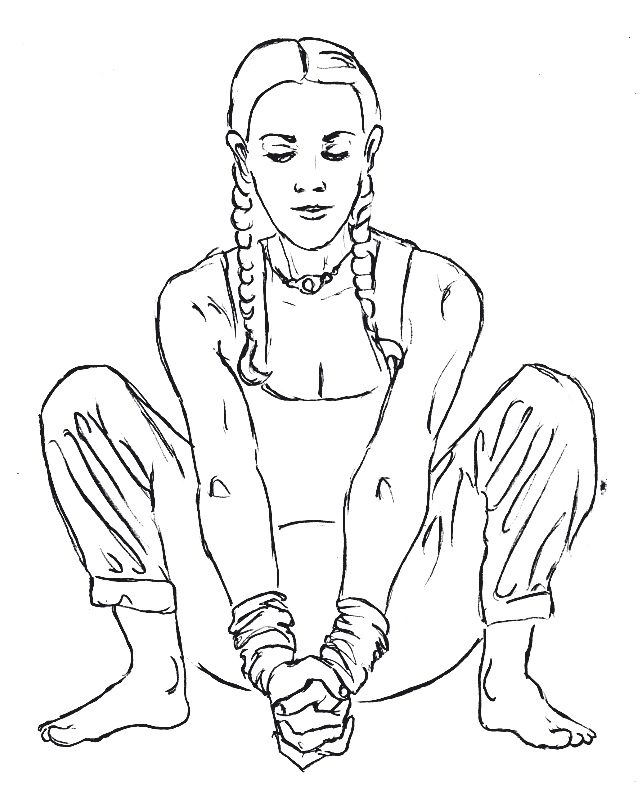
Inhale and raise your arms so that they form a line with your back. Then exhale through the mouth and let the fists fall powerfully downwards, as though you were chopping wood. When the fists touch the floor, activate mūlabandha.
Call out “Ha” as you exhale and chop downwards. Look down at the floor and set a strong tempo in movement and breath. At the end, hold the breath and draw mūlabandha.
Perform this exercise with powerful, rhythmic breathing that gradually becomes faster, for 1–3 minutes.

Namaskārāsana – the Salutation Posture
Come into the squat and form namaskāra mudrā. Open your knees with the help of your elbows and keep the spine upright.
Breathe in deeply and, as you inhale, extend your upper body horizontally above the floor while stretching the arms out straight. Exhale and return to the squat with a straight back and your gaze directed forward. Your hands come back into namaskāra mudrā.
Practise with deep breathing for 1–2 minutes.

Vāyu Niṣkāsana – the Wind-Releasing Posture
From the squat, take hold of the inner edges of your feet, thumbs pointing upwards and fingers reaching underneath the feet.
In this squatting position, inhale, draw your back straight, tilt your head back and look up into the cosmos. Hold the breath for a moment and activate mūlabandha. Then exhale, straighten your legs, bend forward and turn your gaze inwards. Hold the breath out and activate mūlabandha again.
Move up and down in the rhythm of your deep breathing. At the end, exhale deeply and hold bāhyakumbhaka, the outer retention of the breath.
Move with deep breathing for 1–2 minutes. Afterwards relax in vajrāsana, the seat on the heels.

Vajra Balāsana – the Dynamic Thunderbolt-Child Posture
Come into vajrāsana, sitting on your heels. Bring your arms behind you onto your back so that your fingers point down and your thumbs point forward. The hands rest on your back directly above the pelvis, while you draw your elbows close together.

As you inhale, lift your chin, arch your back and keep your elbows as close together as possible. Breathe in slowly and deeply.
With the exhalation, guide your chin gently back towards the chest and fold your upper body forward from the hips. Let your forehead touch the floor and hold the exhalation for a moment in silence.
Inhale, come up slowly, arch your back and open towards the sky. Repeat this sequence with slow, deep breathing for about one to two minutes.
This posture fosters inner calm and quietens the mind. After a few rounds of deep breathing, relax in vajrāsana with your chin on your chest, similar to jālandhara bandha.
Practise this posture with deep breathing for 1–2 minutes.

Udarākarṣaṇāsana – the Abdominal Massage Posture
Sit on your left heel with your left knee on the floor in front of you. Your right foot stands beside the left knee, the knee upright. Your left arm is extended, the hand resting on the left knee. The right hand rests on the right knee. This is your starting position.

Inhale, lift the body gently and turn it to the left. As soon as the body passes the centre, exhale and let the buttock come to rest on the right heel, your right knee on the floor and your left leg upright. Turn your body further to the left and look over your left shoulder, to massage your abdomen even more deeply on the exhalation.
In this way your body makes a 180-degree movement and comes to rest in the exactly mirrored position. Move and turn your upper body from left to right in this way, while noticing the rising heat in the body.
Turn with deep breathing for 1–2 minutes.
Then relax in vajrāsana for three deep breaths; feel the warmth in your thighs and under your hands. Your vital force lies in your thighs.

Śavāsana – the Corpse Pose
Lie down on your back and relax deeply, palms facing up. Imagine that you are floating in space and expanding.
Recognise your strength and your life. You are allowed to be, and you need hold on to nothing, because everything is already there. Be thankful.
The Series at a Glance
- Rajju karṣanāsanā – Pulling the rope
- Titalī āsana – The butterfly
- Cākī cālaṇāsana – Turning the millstone
- Nauka sañcālanāsana – Rowing the boat
- Gatyātmaka meru vakrāsana – Dynamic spinal twist
- Kāṣṭha takṣanāsana – Chopping wood
- Namaskārāsana – Salutation posture
- Vāyu niṣkāsana – Wind-releasing posture
- Vajra balāsana – Thunderbolt-child posture
- Udarākarṣaṇāsana – Abdominal twist
- Śavāsana – Corpse pose
With that the trilogy is complete: part 1 opens the joints, part 2 builds fire in the centre, part 3 sets the energy flowing and anchors it below. Practised in this order, the three series are a complete path through the energy body – and the foundation for everything that follows in our school.

Śakti Bandha, Apāna and the Satyananda System – Frequently Asked Questions
What does Śakti Bandha mean?
Śakti is force, energy, the feminine principle of the universe. Bandha literally means fetter, binding, lock – in yoga usually the conscious lock, as in mūlabandha or jālandhara bandha.
In the name of this series, however, bandha stands for something else: for the blockage. Śakti bandha are the places where the force is stuck. In English the series is therefore often listed as “energy block postures” – postures against the blocking of energy. Both readings belong together: you release the unconscious binding by practising the conscious lock.
What is apāna – and what does it have to do with the five vāyus?
In yoga, prāṇa is not one single thing but divides into five vāyus, five “winds”, each with its own direction and task:
- Prāṇa – in the chest, takes in: breath, impression, food.
- Apāna – below the navel, streams downwards and outwards: elimination, birth, letting go, grounding.
- Samāna – at the navel, digests and distributes.
- Udāna – in the throat and head, leads upwards: speech, expression, uprightness.
- Vyāna – throughout the body, pervades and connects.
Pavanmuktāsana 3 works deliberately with apāna. Hence the squat, hence mūlabandha at the end of almost every exercise, hence the emphasis on hips, pelvis and legs. A weak apāna shows itself as listlessness, constipation, insecurity; a wild apāna as restlessness. This series brings it into a rhythm.
In Kundalini Yoga this is more than physiology: the union of prāṇa and apāna in the navel centre is regarded as the moment in which the force begins to rise along the spine. If you are interested in the map behind this, you will find it on our page about the chakras and in the article on Svādhiṣṭhāna, the centre in the pelvis.
Why is this series so often practised in a squat?
Because the deep squat is the most natural eliminating and birthing posture of the human being – the shape in which apāna can flow downwards unhindered. In most cultures where people live without chairs it is an everyday resting position. With us it has all but disappeared.
For many Western practitioners this is the real challenge of the series: not the strength, but the squat. If your heels do not reach the floor, put a folded blanket underneath. That is not a makeshift solution but the correct answer.
Why do you call out “Ha” when chopping wood?
The sound completes the exhalation. A “Ha” from the belly empties the lungs more deeply than a silent exhalation ever could – and it carries something out with it. Old anger, heaviness, the residue of days on which you pulled yourself together.
It is also one of the few places in yoga where sound is expressly allowed. Use it. Whoever does this exercise quietly does it by halves.
Why does bhrāmarī appear so often here?
Bhrāmarī, the humming of the bees, is the counterpole to the powerful part of the series. After every dynamic exercise you return to the butterfly and hum – and the nervous system settles without the generated energy evaporating.
The sound calms the mind and expands the self. It is the bridge between movement and meditation. If you leave out this alternation, what remains is effort where practice should be. You will find more on this way of practising in our YACEP meditation workshop.
Who was Swami Satyananda – and what is the Satyananda system?
Swami Satyananda Saraswati (1923–2009) met his teacher Swami Sivananda in Rishikesh at the age of twenty and was initiated into the monastic order in 1947. In 1962 he founded the International Yoga Fellowship Movement, and in 1964 the Bihar School of Yoga in Munger on the Ganges. In 1988 he handed over its leadership to his successor, Swami Niranjanananda.
What is known today as “Satyananda Yoga” or “Bihar Yoga” is a system that brings together six paths of yoga: Haṭha, Rāja and Kriyā Yoga as outer practice, Karma, Bhakti and Jñāna Yoga as inner paths – head, heart and hands. He wrote more than eighty books; Asana Pranayama Mudra Bandha of 1969 is still one of the most widely used manuals in yoga teacher trainings worldwide. Inseparably linked with his name is also Yoga Nidrā, the modern form of guided deep relaxation.
Is Satyananda's Kundalini Yoga the same as the one known in the West?
No, and this confuses many people. There are two large currents that are both called “Kundalini Yoga”, historically related but different.
Satyananda's approach is that of a monk in the Sivananda lineage: systematically built up, tantrically grounded, with kriyā, yoga nidrā and a long preparatory path through āsana, prāṇāyāma, mudrā and bandha. The variant that spread in the West from the 1970s onwards is considerably more immediate: short, powerful sets with Breath of Fire, mantra and white clothing. How this second lineage came about, and what part sūkṣma vyāyāma played in it, we described in detail in part 2 of this series.
Our own lineage, in turn, sits fully in neither of them – we come from the Trika Tantra of Kashmir. If you want to know what that means, you will find it in the article about our teacher Mark Dyczkowski and on our page Yoga and Philosophy.
What sets part 3 apart from parts 1 and 2?
Part 1 is fine and meditative, seated, joint by joint. Part 2 is warm and concentrated, lying down, everything around the navel. Part 3 is the most physical and the loudest: dynamic circles, twists, the squat, a shout.
Energetically the movement goes from the outside inwards and downwards – from the periphery through the centre to the base. That is why the order is not accidental, and why part 3 is not the right entry point if you have never worked with this kind of exercise before.
When should I not practise this series?
With knee problems the deep squat needs care – work with a support under the heels or leave out the squatting exercises. Restraint is also called for with acute back complaints, disc problems, during pregnancy, after abdominal surgery and in the first days of menstruation.
This article describes yogic tradition and is not a substitute for medical advice. If you have complaints, please speak to your doctor.
Where can I learn the three series with guidance?
In our Kundalini Yoga classes in Vienna all three parts are a fixed component of the practice. We cover them systematically – with anatomy, the energy model and didactics – in the RYT 200h yoga teacher training and deepen them in the RYT 300h training; both are also available as online and hybrid training. For teachers, the YACEP Kundalini training is the right setting, and if you want to go deeper into sound and silence, the chakra workshop is the place. A look at who we are will show you the people who walk this path.
Even more inspiration for you
If you would like to dive deeper, do take a look at our download area.
There you will find a lovingly assembled selection of Kundalini Yoga kriyās, mantras and other beautiful impulses that I have put together for you.
And if the world of thought behind the practice interests you: Yoga and Philosophy gathers our texts on the subject, and The Chakras answers the question that sooner or later everybody asks.